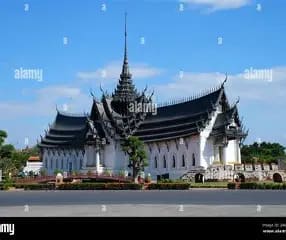
Meditation at Wat Dhammakaya. Many believers, in all the main religions, practice some form of meditation. In Thailand it is an essential part of being a Buddhist. It is the path to enlightenment and seeking eternal truth.

Monks will tell you that by meditating regularly and deeply you will realise the impermanence of life. You will become aware of a more important goal: stopping the continual cycle of rebirth and reaching Nirvana.
Worshipers in the wats may not comprehend the complexities that are being rather mystically explained. They are unlikely to be able to discuss them with you.
They will tell you only that life is not permanent. They will emphasis the importance of acquiring good karma so that you can be reborn in better circumstances.
Few members of any religion are that knowledgeable about their church’s teachings, they rely on a sense of faith.

Meditation at Wat Dhammkaya
Attending meditation at Wat Dhammakaya can be both thought provoking and a little mysterious.
Six evenings a week the abbot gives a sermon on Buddhist teaching, invariably it is linked to a meditation topic. Foreigners are regular visitors and are provided with headsets to enable them to hear the abbot’s words in translation.
On Sundays, the hall where the abbot gives a sermon is packed with both Thais and a significant number of farangs. Most attendees are dressed in white and sit cross-legged in a one metre square chalked out area facing the abbot.
The main focus is on the abbot’s sermon, where he interprets dreams experienced by others during their meditations.
An Unexpected Meditation Setting. The Underground Car Park
It’s very spacious, a facility for thousands of cars. It supports the floors above with several ornate pillars.
I asked a monk what he saw when he himself meditated. He refused to answer. Instead, he asked me,”what did you observe during your meditation”.
“A calm and serene room with what seemed to be angels dressed in shining white clothes, walking peacefully between ornate pillars. It was heaven.”
Only later did I realise, I was describing the car park.
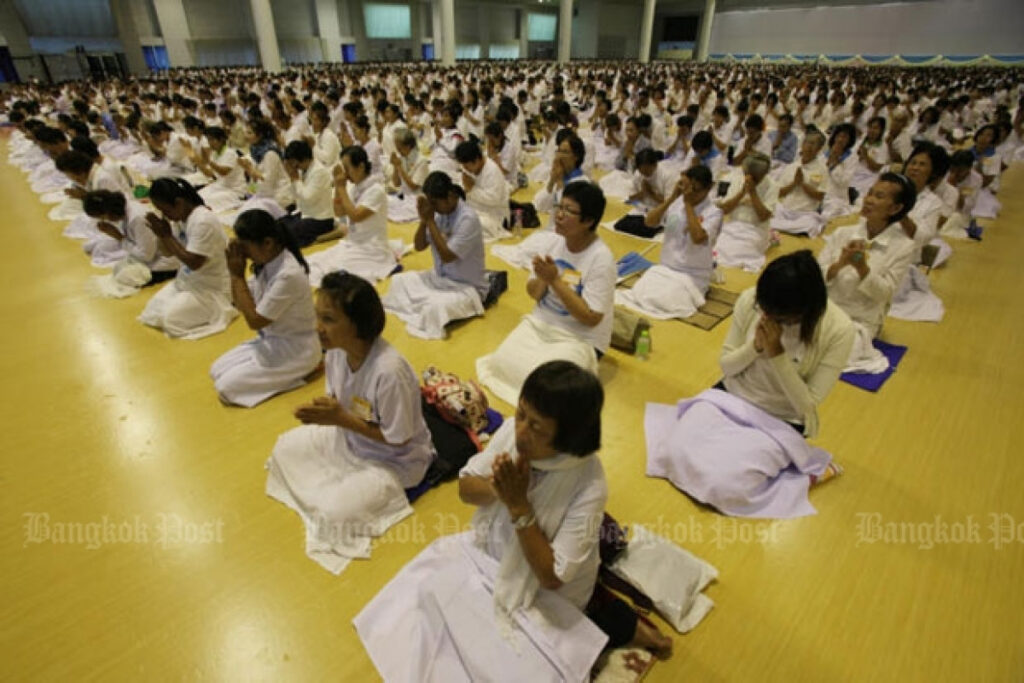
Meditating before meeting Abbot Dhammajayo
Meditating at Wat Dhammakaya. The congregation line up to make donations, handing them directly to the abbot. It’s regarded as making merit rather than making a donation.
After an hour, a saffron coloured strip stretching from the abbot’s hand to the centre of the hall is laid out. Those whom the abbot will not have time to see individually can place their offerings on it.
Symbolically, he is able to accept each person’s merit before leaving to return to his quarters.
The services are unlike anything we see in the West.
The buildings and grounds are in immaculate condition. The monks do not walk the daily alms rounds, there is an on-site kitchen and refectory. The wat broadcasts on satellite TV and has overseas branches.
The emphasis, in their headquarters near Bangkok, is on the two meditation halls and the teaching of mediation techniques. The bot, the central part of most temples, can be visited. It’s not near the main buildings and you won’t see many people inside.

The Thai government drops charges
The Thai government has formally dropped charges against Phra Dhammajayo. The former abbot of Wat Dhammakaya is now free and out of hiding. The statute of Limitations in the high-profile money laundering case expired in March 2026.
The DSI informed complainants on 20 March 2026 that the Office of Criminal Litigation 4 had closed the case. Consequently, Chaiyaboon Suddhipol, better known as Phra Dhammajayo, and his associates have legally escaped justice.
They had been charged with money‑laundering and receiving stolen property in a multi-billion-baht embezzlement at Klongchan Credit Union Cooperative (KCUC)
According to the agency, the case carried a 15‑year statute of limitations counted from the last cheque issued in 2011. Investigators can’t now bring the monk before the court within that timeframe,. The criminal case has expired by law and can no longer proceed.
The complaint was filed by lawyer Thammanoon Attachote on behalf of about 40 KCUC members. Five suspects — including then‑cooperative chairman Supachai Srisuppa‑aksorn and Phra Dhammajayo — were accused of receiving more than 1.4 billion baht in embezzled funds. They had been channelled through cheques allegedly donated to the temple and its network.
The DSI began examining irregular financial flows in 2013 and, by 2015, had issued charges related to money‑laundering and stolen property. But efforts to bring the monk in to hear the charges repeatedly stalled.
Between March and May 2016, summonses were issued, but temple representatives said he was too ill to travel. An arrest warrant followed on May 14, 2016, after he failed to appear.

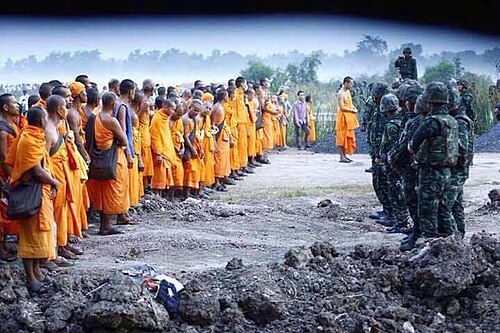
Officers attempting to enter Wat Phra Dhammakaya in Pathum Thani province were met with mass sit‑ins by followers, blocking access.
In February 2017, the then-military government of Gen Prayut Chan-o-cha declared the temple a restricted area. He invoked the Section 44 emergency law, prompting a three-week search involving thousands of police, soldiers and DSI officials. Not an easy task. Dhammakaya is 10 times the size of the Vatican City.
Investigators combed dozens of buildings but, in his private quarters, they discovered several blankets had been placed under the covers. It looked as if Dhammajayo was just sleeping. He had already fled.
Civil Actions Unaffected
A source at the Anti‑Money Laundering Office (Amlo) said the end of the criminal case would not affect the civil proceedings. Most of them had been concluded years ago. Authorities have already seized and confiscated more than 1.4 billion baht in assets linked to the KCUC embezzlement.

The Courts have ordered these assets transferred to the state for partial repayment to cooperative members. Some remaining properties — including meditation centres in other provinces and the well‑known “globe-shaped building” inside Wat Phra Dhammakaya — are being auctioned.
Conclusion

Phra Dhammajayo’s story is one of extraordinary rise and enduring controversy. From humble beginnings in rural Thailand to leading one of the country’s largest and most modern temples, his journey reflects the tensions between faith, wealth, and power in contemporary Thai society.
The following account traces his path from ordination to disappearance. And finally to freedom when the statute of limitations declared that he could no longer be tried.

Early Years
Phra Dhammajayo, born Chaiyaboon Suddhipol in 1944 in Sing Buri Province, grew up in a modest household. Education was seen as the path to advancement.
He studied at Kasetsart University in Bangkok, where he encountered Buddhist meditation practices that would shape his future. His spiritual curiosity led him to ordain as a monk in the late 1960s, taking the name Phra Dhammajayo. From the outset, he displayed charisma and organisational skill. He envisioned a modern Buddhist movement that could appeal to Thailand’s growing middle class.
Founding Wat Dhammkaya
In 1970, Dhammajayo, established meditation at Wat Phra Dhammakaya in Pathum Thani. The temple began as a small centre but quickly expanded. Its teachings emphasised meditation as a path to inner peace. Merit‑making practices promised prosperity and success.
This combination resonated with urban Thais navigating rapid economic change. Wat Phra Dhammakaya grew into one of the largest temples in Thailand, with vast grounds and futuristic architecture. Their ceremonies drew tens of thousands of followers.
The rapid growth was not just architectural but ideological, laying the foundation for a new kind of Buddhist movement that would soon extend far beyond Pathum Thani.
The Dhammakaya Movement
Under Dhammajayo’s leadership, the temple became a global movement. He promoted meditation techniques that were accessible. As Abbot, he marketed merit‑making as a way to achieve both spiritual and material benefits. His teachings aligned with Thailand’s consumer culture, presenting Buddhism as compatible with wealth and success.
The temple pioneered large‑scale donation campaigns, always linked to promises of spiritual rewards. It used television, publications, and later digital platforms to spread its message. Yet this success attracted criticism. Traditionalists accused Dhammajayo of commercialising Buddhism, turning temples into fundraising machines, and distorting doctrine.
That criticism intensified when financial scandal struck, pulling the temple into the national spotlight for reasons far removed from meditation and merit‑making.
Legal Troubles Begin
The turning point came in 2013 with the Klongchan Credit Union Cooperative scandal. Billions of baht were embezzled from the cooperative, and investigators alleged that Dhammajayo had received large sums through donations. Authorities charged him with money laundering, receiving stolen property, and encroachment on public land.
The Department of Special Investigation pursued the case vigorously, seeing it as emblematic of corruption within religious institutions. In 2017, the government staged a dramatic siege of Wat Phra Dhammakaya. For 23 days, thousands of police surrounded the temple, attempting to arrest Dhammajayo.
Yet he remained elusive. Supporters blocked entrances, and rumours spread that he had fled. The siege ended without success, marking one of the most embarrassing failures of Thai law enforcement in recent memory. Thai culture teaches avoidance of conflict. Added to that, Dhammajayo had influential friends.
What followed after the failed siege was even more mysterious, as Dhammajayo himself seemed to vanish from view
Disappearance after the Siege
After the failed siege in 2017, Phra Dhammajayo vanished from public view. Some claimed he remained hidden within the sprawling temple compound, shielded by loyal disciples. Others suggested he had fled abroad, possibly to Europe, though no evidence ever confirmed his whereabouts.
His absence only deepened the mystery and fuelled speculation. Despite his disappearance, Wat Phra Dhammakaya continued to operate, though under constant scrutiny. The temple’s vast resources and devoted following ensured its survival, even as its reputation suffered from the unresolved scandal.
The legal drama finally came to an end in 2026, when prosecutors announced that all charges had expired under the statute of limitations.

Statute of Limitations Ends the Case
On 20 March 2026, Thai prosecutors announced that all charges against Dhammajayo had expired under the statute of limitations. At 82 years old, he was effectively free from prosecution. The decision sparked outrage among critics, who saw it as evidence of systemic weakness in Thailand’s justice system.
Thailand has a reputation of not holding powerful figures to account. For supporters, however, it was vindication—a sign that their abbot had been unfairly targeted and persecuted for years. The announcement closed a chapter that had dragged on for more than a decade, though it left many questions unanswered.
His contested legacy continues to shape debate, dividing followers and critics in their interpretation of his life’s work.
Legacy and Impact
Phra Dhammajayo’s legacy remains deeply contested. For followers, he is still a revered teacher who modernised Buddhism and brought meditation to millions. The abbot presented it in a way that resonated with Thailand’s middle class and global audiences.
Critics said he symbolised the dangers of mixing religion with wealth and power. He symbolised the failure of institutions to hold leaders accountable. His case highlights the tension between tradition and modernity, faith and commerce, and law and impunity.
Wat Phra Dhammakaya is one of the largest temples in the country, its golden dome visible for miles. Yet, its reputation is inseparable from the controversies surrounding its abbot.
Reflections
Phra Dhammajayo’s journey from novice monk to fugitive abbot encapsulates the complexities of modern Thai Buddhism. His rise reflected the aspirations of a society in transition. His fall exposed the vulnerabilities of religious institutions entangled with money and politics.
Ultimately, his escape through the statute of limitations leaves a lingering question: was justice denied. Or, was it never truly possible in a system where power, faith, and wealth are so deeply intertwined?

A trusted external link
This link takes you to a full account of the life of Dhammajayo, the former abbot of Wat Dhammakaya. From his time as a novice monk to when the Statute of Limitations resulted in his escaping justice. He’s now a free man. The courts can no longer deal with his fraudulent activities while supervising meditation at Wat Dhammakaya.
http://Readers and followers may like this post from my site, www.understanding-thailand.comhttps://understanding-thailand.com/meditation-at-wat-dhammakaya/https://en-wikipedia.org/wiki/Luang_Por_Dhammajayo
©Mattowensrees
The content and final editing remain my own.