Derek wonders if he is truly integrating into Thai society, sharing coffee-shop pen portraits of fellow expats and reflecting on the cultural gaps that still unsettle him
Feeling Alone.
Derek feels happily married but concerned he’s not fully integrating into Thai society. He loves helping out at Toy’s school, teaching the kids English nursery rhymes.
On Fridays, he meets with Roger and they make pen portraits of Paul, Alfie, Janet, Nolan, Louis, Daniel and Emily. Discussing how some fit into Thai culture better than others.
Derek explains why Andrew Drummond, the renowned investigative journalist, had to leave Thailand because he exposed the criminal activities of the élite.
Although I feel happily married in Thailand, I still think about how I am coping with what is in reality a very unusual life style and if I am truly integrating into this country.
I don’t think marrying Toy was love on the rebound. I don’t believe it was a reaction from my two failed western marriages. Toy and I have had lots of fun together and she is a most caring lady. We are blissful enough together and enjoy each other’s company.
We don’t see much of each other during the day. I am at my computer; she is teaching in the classroom. Computers can get addictive but I get pleasure watching YouTube and the UK TV channels, If I need a break, I’ll do few chores around the house. Some days, I take her to school and we have lunch together. Perhaps each day is getting a bit repetitive.
I help out teaching English at Toy’s school. Nothing serious: reciting English nursery rhymes, pointing to parts of the body and asking the youngsters for the name in English, teaching them colours, counting the numbers one to ten, and other light exercises in learning. I enjoy it. They enjoy it. I do get tired quickly, which the teachers have noticed and they have expressed concern.
Having now taught in a modest sort of way, I now appreciate how exhausted and stressed teachers can become when standing in front of a class of thirty to forty pupils all day long.
I like to have a coffee with a few friends every Friday, but because Toy goes upstairs whenever a farang comes round to see me, we now always meet at a local coffee shop. She is rather shy but she does not do that with her Thai friends. Sometimes she has made arrangements for the day and I have to cancel at the last minute.
It’s a pleasant break for me when I go out for a coffee. Roger sometimes joins us for our Friday get-together and we often talk about expats in Thailand and how some fit in here better than others. Discussions like this one on Asean Now. (Asean Now can be a rather controversial forum. Lots of arguing)
https://aseannow.com/topic/1319981-expat-clubs-why-dont-you-go/#google_vignette
Over a few coffees, we pieced together some short pen portraits of those we know.
I don’t always agree with Roger and the other friends we chat with at our Friday meet-ups. I think they’re being a bit too critical and analytical; they think I see only what I want to see.
Now Paul, He’s Interesting
Paul is an interesting character. He lives just a few hundred yards away on my housing development. I fell out with him over some trivial matter and neither of us would back down. We do not speak to each other anymore.
I admit I spend some time surfing the Thai internet forums as I did in the UK. He appears to spend the whole of his time glued to a computer screen. He is a bit contrarian, always disagreeing with whatever a poster says. That seems par for the course on almost all Thai forums. New members particularly get a right old bashing in the flame wars.
Social media can be like that. Does the lack of face-to-face contact brings out the worst in people? They can hide behind their pseudonyms.
I tend to skip those arguments and read only topics of interest and those that may be useful. I read more than I post. Most expats say they do the same. Take the posts with a pinch of salt, but surf a few forums for yourself and you will get what I mean. The least biased forum for farangs, in my view, is https://www.andrew-drummond.com
Run by a freelance journalist with experience in the UK press; he is a bit of a terrier when it comes to discussing expat issues. He won’t let go when he takes up a reader’s case. He has uncovered many injustices towards foreigners in Thailand.
As an ex-News of the World journalist, he can be a bit sensationalist. It goes with the job I suppose. He has an attacking style of writing which sometimes encourages the grumpier type of expats to respond with their negative views of Thailand.

His most high-profile investigation involved tracking down rock star Gary Glitter in Vietnam, leading to his prosecution on child abuse charges.
Drummond faced extensive legal retaliation in Thailand from criminals he exposed, becoming one of the most sued journalists in the world.
Andrew Drummond left Thailand for England in early 2015. Multiple reports from January 2015 confirm his departure, with his own statement explaining that after 25 years in the country, staying had become too dangerous for him and his three children, aged 8, 6, and 3 at the time.
He had got too close to exposing the truth about some highly influential Thai people. The threat was very real and Drummond left immediately for England. He still posts on Thai corruption on his site but it remains banned in Thailand.
Drummond had received threats from a group whom he had quoted as “killed with impunity before”. He had been convincingly told they had manipulated police to set people up on false charges.
In a 2-year period, he faced around 20 cases from foreign criminals. While Drummond won most, the process was designed to financially ruin him. In Thailand, accusers don’t have to pay a defendant’s legal costs even if they lose. That allowed them to file endless frivolous cases.
Even after winning a case, defendants would not be allowed to leave Thailand for months while paperwork was “processed”. It was getting virtually impossible to carry out his role as an investigative journalist.
His departure was seen by colleagues as a major loss to journalism in the region, with one editor noting, “a safe environment for journalists to work in is essential to the country’s well-being”.
Bashers and Apologists
Matt and I agreed that, although there are some posters that can see both sides of an issue, most seem to be either Thai bashers or Thai apologists. Taking extreme views as if everything was only ever black or white in this country.
I think some of the bashers have been badly burned here and have lost a great deal of money. The bulk of their life savings may have disappeared through property scams or putting everything in the name of a Thai wife or girlfriend. The Thai apologists never admit to anything being wrong about Thailand.
Forum posters argue about dual pricing and what they consider a bias against the farang when it comes to resolving disputes. They have a point but they never seem to see the Thai side of an argument or that there are other more pleasant aspects of life in Thailand.
Paul is a basher if ever there was one. In small doses, he was thought-provoking to talk to but many of his stories seem a bit far-fetched. To be fair, he was more reasonable in normal face-to-face conversation. Forums where you post anonymously can make some posters more aggressive. Toy hated him and would never speak to him.
Then there is Alfie, whom we know only through an internet forum. A complete contrast. He is a model Thai apologist. His standard response to a news report on the murder rate or road fatality figures in Thailand is to say that you get violent deaths in all countries in the world.
Of course, he’s right. The issue, though, is that it happens more here than elsewhere. He won’t accept that. To him everything in the garden looks beautiful when he wears his rose-tinted glasses.
I hope I am more objective and not so biased. Though I probably do like to put the more unpleasant aspects of life here to the back of my mind. It is a mai pen rai response, I think. If you can do nothing about it, no point thinking about it. Let it go. It will not change anything.
It’s also a common Thai response and Thai apologists follow suit. In the West, we accept criticism about our countries. We actively join in the fray. Thais think it is wrong to criticise their homeland.
Thais have to be happy with their lot. Revolutionary ideas do not come naturally to them. However, when they are pushed too far they do let rip and demonstrations can get out of hand. During the October 1973 riots at Thammasat University, the King called for calm and peace but was even handed in his condemnation of both sides.

The Thai king, Bhumibol IX, talking to his subjects
An Appetite for Change?
The various coups by the military, the actions of big business, and the élite all showed there was an appetite for change. However, demonstrating for such causes is certainly not a trait with which Thais are comfortable. They prefer avoiding conflict. Keeping the status quo would have avoided a lot of bloodshed in 1973.
It is not always advantageous to demonstrate or give one’s opinions. Mai pen rai and “no conflict” rearing its head as usual.As Matt said, Thais can be on their guard if their partners get too close or familiar with other expats. They do not know what advice and comments their partners may be receiving from their farang friends. It could change a Thai wife’s relationship with her own farang. There was a ring of truth in what he said. Toy always asks me what we’ve been talking about after I return from my Friday get-togethers.
She can be a bit suspicious. I think she believes that other farangs may be a bad influence on me and try to convert me into an anti-Thai type of guy.
I do get embarrassed when Toy disappears when friends comes round to see me. I don’t show my feelings and I make excuses, but they feel snubbed and have said so. During one dinner with fellow expats at a restaurant, she sat with an earplug connected to her iPhone all evening listening to music. We must allow for idiosyncrasies like that.
Thai wives do come across as being possessive of their partners, especially if they are farang. It is as if they are saying, “keep away, he is mine.”
I’d been told before that Westerners are said to be poo dee angkrit. Poo, a word that does not sound too good to a western listener, is actually a term of great respect in Thai. It is used for judges and senior government ministers, for example. Dee is good, angkrit is English.
Ask a Thai what they find characteristic of a person they call poo dee angkrit and they will tell you it means someone (not necessarily English. It could be any Westerner) who is generous, caring, trusting, malleable, and polite. These are the adjectives they will commonly use.
A Thai can wrongly assume that these characteristics indicate naivety and may try to take advantage of a foreigner. I don’t think Toy does but I must accept that some Thai wives see their husbands as walking atms.
However, many Thais are aware that some foreigners, particularly those who are fluent in Thai, are quite astute and are au fait with how Thais do things. They can understand what the Thai is saying and comprehend some of the aspects of Thainess that Thais would prefer them not to contemplate. I remember an example that Paul often quoted about his friend, Janet.
Janet was in a car with her friend when it hit a motorcyclist who had come out of a soi without paying attention. He had crossed the lane in which she was driving to get to the other side of the road. Janet’s friend swerved to avoid him but clipped the rear end of his bike. It was plainly the biker’s fault. He did not have right of way.
His bike was straddled across the carriageway. Janet’s friend had not been speeding and had done all she could to avoid the collision.
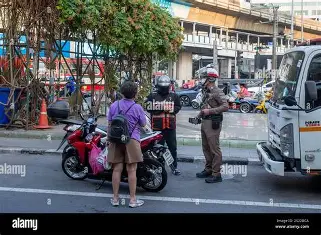
But in Thailand, the important stage is “bargaining”
But he was Thai. When the police arrived on the scene they drew chalk marks round the positions of the car and bike. They took statements. The biker had no money with him. He may well have been uninsured and with no means of repairing his bike out of his own pocket. His bike was badly damaged. The car had only minor scratches and some chips in the paintwork.
You pay, were the only words the officer spoke when he went over to Janet’s expat friend. Having to pay when not at fault is not only for farang. Well-off Thais have to do the same; they would usually volunteer a payment. Not to do so would mean losing face.
With the motor cyclist, it then became a question of how much to settle for. Janet, listening to the conversation, knew that the rider was suggesting twice the normal rate because the accident involved a farang. She negotiated the price downwards. It makes the point that Thais do not like those farangs who, usually because they speak the language, know what is going on, and cannot be easily fobbed off.
They refer to them as khun roo reuang ( literally, someone who knows the story.) We would probably say of such a person, “there are no flies on him, he is street wise,” someone who knows too much about what is going on. Janet’s friend paid the Thai price but both the officer and the rider would have preferred to have been dealing with a more naive foreigner and not a khun roo reuang.
I had an internet problem and the technician wanted 3000 baht to replace some wiring. I did what a Thai would do; I asked to see the wire he took out. He could not show me. He had not replaced the wire at all. I intended not paying the full amount; Toy said we would have to pay it otherwise we would lose face and appear mean and stingy.
He would lose face for having been caught out. Paying would be better for both parties, she said. The solution would be not to use him again. This face concept just would not occur in the West. I accept it now as a cultural quirk though I admit I do not fully follow the logic. We paid, but looking back, I should have given the Thai what would have been a fair Thai price, not the farang price he was asking for.
If a taxi driver or motorbike taxi takes you to the wrong place, you need to pay the fare. He may have If a taxi driver or motorbike taxi takes you to the wrong place, you need to pay the fare. He may have misunderstood you but he has spent time and fuel getting you there. That is the Thai reasoning and applies to both Thai and foreign customers.
I recall Nolan, a Swiss guy who always dressed in Lanna costume, telling me that Thais do not think like us. It was an obvious comment, rather a throw away line. I thought nothing of it at the time. On reflection, I think he is right. Nothing is in reality that serious to the Thai mind. Mai pen rai overrides most of their actions. It doesn’t matter. Westerners can get serious over even minor issues.

Apart from some western occupied houses, homes are not earthed. Electricity is different in Thailand! That comment came from a Thai electrician and he genuinely believed it. Justifying an action as being right is an attribute that you will notice frequently in your relationships with a Thai.
Perhaps they are impervious to doubt; or perhaps they like making up a story and embellishing the facts just to rationalise what they do.
Asking, “Do you think doing it this way is better?” would be the Thai way to get around their trying not to carry out an electrical job the way you want it done.
Most definitely, do not raise your voice or get angry.
In businesses, Thai managers have a slight lead over the farang manager. As they are Thai, their workers automatically give them respect. They have higher status and the worker cannot easily question an instruction.
The farang does not have that benefit. It is harder for him. The best way forward is to speak calmly and politely, not rush in by arguing, and be as persuasive and complimentary as you can. That is what Nolan suggested. Perhaps I should listen to advice like that.
Thais have a stronger belief in Karma, the law of cause and effect, than we have. Your harmful thoughts, ideas, and actions will come back to haunt you. Your good and bad deeds in this life and in your previous lives will determine how you are reborn. As you sow, so shall you reap? Retribution for what you do will get back to you. Not now, but certainly in the future.
Yes, Nolan had given many examples showing they don’t think like us.
I think we need to get on their wavelength without completely throwing away our own western standards, principles, and ways of thinking. Finding the right balance is essential.
Louis has found that balance. He was looking for someone who would care for him as he got older and with whom he could share his life. His wife’s goal was to find a farang. It is a key reason why Thai women choose foreigners.
As I said before, Toy said she had had a bad experience with a Thai man. The reason she had been on an English language internet site in the first place was to chat and date with a farang with a more caring attitude and more money. (I wish!)
Louis is Belgian. Mem, his Thai wife, is a retired teacher. They have an understanding in their relationship. They live happily together and are under no illusions why their marriage is working out so well. She cares for him. He provides her with the security that all Thais need. He is older and he knows she will continue to look after him when he gets less mobile or ill.
Thais are very family oriented. They look after their relatives. Old folks’ homes are abhorrent to them. Caring comes naturally to a Thai; it is built into their thinking.
Louis and Mem met in Belgium and he accepted that her purpose in marrying him was to ensure her own future and not to find the most handsome man on earth. My friends know several expats who honestly believe they were chosen as a marriage partner for their looks and charisma. They should re-think and consider the reality. To thine own self be true.
Sometimes, I wonder if Toy would have married me if I had not been a moderately well off bank manager. But the thought soon leaves my mind and I reflect on how much my Thai goddess and I are happy together.
Every time I see Louis and Mem, they appear in high spirits and contented. They both know the score. They both understand why they married and the benefits they both get from the relationship.
I introduced Daniel and Emily to some of the teachers in Toy’s school and they became interested in helping out in the English infant classes. The school organised some positions for them in other schools with which they have contact. They visit Thailand every year for an extended holiday, staying in guesthouses. They like to get involved with the locals.
I think teaching at that level can be very beneficial for the pupils. Technically, work permits are required, but blind eyes are turned as they are providing a useful service. In more senior classes, the Thai authorities should be looking at using better-qualified teachers rather than allowing backpackers and retirees into the classroom.
When not teaching, Daniel and Emily spend their leisure time visiting Thailand’s tourist attractions. This fits in well with their holiday plans.
The Thai Belief in Karma
As Nolan pointed out, the belief in karma – that actions return to you in this life or the next – runs deeper in Thai thinking than many Westerners assume.
I think we need to get on their wavelength without completely throwing away our own western standards, principles, and ways of thinking. Finding the right balance is essential.
Conclusion
So where does that leave me? I ask myself this more often than I probably should. Toy would say I think too much. She’s almost certainly right.
I’m aware that I talk too much as well. Roger once said, after I’d held forth for ten minutes on some minor cultural observation, “Derek, you do know you use twenty words when five would do?” He was smiling when he said it. People tend to smile when they tell me things like that.
I’m not sure if that’s a good sign or not. Perhaps they think I need to be handled gently, like a well-meaning uncle who’s had one too many at Christmas.
But here’s the thing. They still turn up on Fridays. Roger, Matt, the others. They listen to my theories and they tell me I see only what I want to see, and then they order another coffee and we carry on. I must be doing something right.
I don’t pretend to have solved the riddle of living between two cultures. Some days I feel like a khun roo reuang, street wise and nobody’s fool. Other days I’m the farang paying three thousand baht for wiring that was never replaced, and Toy has to explain to me why we’re paying it anyway.
The ego and the self-doubt, they take turns at the wheel. I suspect that’s true for most of us out here, if we’re honest.
But I am happily married. That much is true. And Friday is only a few days away.
What’s coming next in Derek and Toy’s story?
https://understanding-thailand.com/escape-to-thailand-the-full-series/
Some readers have asked what’s my motivation for writing about Thailand, its people and its culture.
https://understanding-thailand.com/about-matt-owens-rees/
© Matt Owens Rees May 2026
The content and final editing remain my own.