Derek’s Disdain for Expat Clubs in Chiang Mai
Derek continues discussing his friends’ reactions to their lives in Thailand. He enjoys chatting with Brits, Americans, the Dutch, and other nationalities living in Chiang Mai, appreciating their accents and learning about their customs.
Expat Clubs, however, are a different matter. Derek hates them intensely. He dislikes how members treat what should be a social event as an opportunity to sell insurance, condos, and canvass for their own businesses—making money off other members. Not Derek’s scene at all. He also notes how some refer to Thailand as if it were a colony of a European or American power.
A heated row erupts between two of Derek’s friends, Rebecca and Barry.
Through it all, Derek observes some of his friends are not fully satisfied with their lives here and miss their homelands.
Expat Clubs.
I found on my first visits to Thailand that expat clubs were not for me. Everyone I met was either around my own age or older. Possibly, some clubs are better than others and are an effective way to meet fellow westerners and socialise.
It was interesting to hear so many English accents. Talking to Australians, Dutch, and other nationalities did broaden my outlook on life but it was in a rather anti-Thai, colonial type atmosphere and I knew I wouldn’t fit into that.
A few expats were unashamedly canvassing for business. Selling or renting a condominium, making a pitch for some investment or insurance business, promoting a massage training school. In a way, they were taking advantage of a captive audience who could not or would not meet with ordinary Thais to get whatever they wanted.
For a sobering example of how expat clubs can become hunting grounds for financial predators, read Andrew Drummond’s investigative reporting on Global Investment Far East:
https://www.andrew-drummond.com/tag/global-investments-far-east/
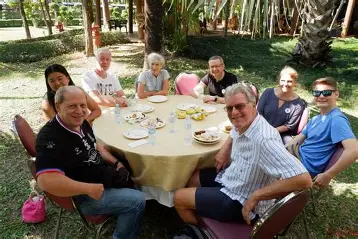
Club members came across as wanting to make money out of the farang and with no interest in making Thailand their home or assimilating into the Thai way. The betting was that they would be back in their home countries in a few years’ time.
One person, Oliver, actually boasted he didn’t like Thai food and would never speak a word of Thai. They should learn English, he said. My friends had not me anyone quite like that since, but it’s disturbing that such people want to stay here.
It is up to them if they treat Thailand as a long-term holiday destination without appreciating the richness of getting to know and integrate with the Thai people. They are missing so much. It’s their business though. There is room for all sorts.
Mark, Gilbert, and Isabel are regulars in the expat clubs. They do not mix with the locals. Mark helps his wife in her massage school. Gilbert and Isabel host a small discussion group on The Meaning of Life. Apart from the Thai wife of one expat, all the participants are farang.
Informative and fruitful as the meetings are, they could just as easily be held on Mars as in Thailand. Gilbert and Isabel are no longer permanent residents, now spending six months in Canada and six months in Thailand each year.
There is a book-reading club run on similar lines. No Thais are present. A gardening club takes a different approach. Thais are encouraged to join in. That appears to be a sensible decision as it taps into a useful source of knowledge. Tropical gardening is not at all like that of the West. It’s more fun too when Thais and farangs, sharing similar interests, can get together.
Daniel had to go to the Immigration office to extend his permission to stay and got chatting to two expats. One had been in Thailand for over thirty years but still believed too much of the political propaganda in the English language dailies that are published in Thailand. Talking politics can lead to arguments, so Dan quickly moved on.
The second man had been splitting his time between Thailand and Scotland over the last six years. He had married a dental technician from Bangkok two years ago and had now decided to apply for a retirement visa so that he could move here permanently. He appeared more tuned in to Thai life, not unquestionably accepting the obvious propaganda. Luckily, I have Toy to tell me what is propaganda and what is not.
Rachel, a friend of Daniel’s, is a retired IT specialist and she is touring the world. It is her first visit to Thailand and she was lodging with an American. They had bitter arguments and she found an alternative place to stay after a few weeks.
It was more than a clash of personalities. Rachel could not make him out. His attitude to relationships and his tendency to Thai bash did not blend in with her own ideas on spending time in a foreign country.
Barry has had several live-in girlfriends and eventually married a Malaysian living in Thailand. One year on, he had divorced her by saying “I divorce you” three times. That is probably not valid in Thai law but, anyway, he is now back with her, having had a few platonic relationships in the meantime.
Rachel moved to a guesthouse where she could meet ordinary people and this new arrangement suited her perfectly. She could not afford to travel the world in luxury and stay in five star hotels. She did not associate with the high society expat crowd.
Rachel neither had their money nor their need for mixing with other Westerners. Rachel had no desire to be seen in the coolest nightspots.
Everyone to his or her own taste, of course. But it was not for her. Rachel didn’t really know, but she thought that many of them were out of their depth and pretending to be high flyers when they were not. “Living above their class,” was how she put it. She felt happier and more relaxed talking to the average Thai and getting to know the Thai lifestyle.
Packman was a former journalist who had worked with a press agency in Europe. For some reason, everyone, his wife included, calls him by his surname. I found him very friendly and called him by his first name, Robin.
A frequent traveller to Thailand he had met and married a Thai national. They eventually settled in Bangkok. The marriage grew a bit stale after a while but they still live together. She spends time helping at the local wat, he is a keen cyclist and enjoys building items of small furniture for the home. They do most things separately.
He probably thinks that he has no options left other than to make the best of his present situation. It is a dilemma when the main asset, your home, is in the wife’s name.
They mainly go out for meals, usually with her friends. Sometimes the conversations can be a tad awkward and cold. He has always been a keen reader of Thai history but accepts that there are some subjects that he cannot talk to his wife about.
He frequently attended some of the seminars given by Thai universities and which are open to the public. Libraries are not as common in Thailand as they are in the West and listening to debates was a useful way to keep up with matters of interest. He was a lively contributor in discussion.
Robin had not found it easy to meet people that shared his love for intelligent conversation. It was what he missed most when he retired as a journalist and first arrived in Thailand. Joining these discussion groups allowed him to meet and associate with the kind of people he had previously worked and went out with. He enjoyed that.
His first impressions of expats in this country were that many were sexpats, would-be high society people, or angry old men who were always finding fault with their adopted country. They may have been in the minority but they made themselves prominent wherever they went. Robin felt he had been lucky to find eventually a group of like-minded foreigners.
Not all were white farangs: many were Chinese, Singaporean, or from Arab countries.
Outside the university campus, there were a few clubs that held monthly meetings on topics of interest, not always Thailand related. Less open and friendly than clubs in the universities. Cliques were inclined to form and you had the occasional “clever clogs” trying to hold forth. Often an expat who had been here a long time but had had little contact with ordinary Thais.
Robin had got to know Peter quite well. Peter was a qualified teacher with a work permit. He worked at a local school teaching English to 15 and 16 year olds. He occasionally gave lectures at the university, which is where Robin had met him.
His contract will hopefully be extended at the end of the year. School authorities give out contracts only on a semester or annual basis in Thailand. They are often not renewed. Resources are not always available. Richard has been in post for three years so clearly they appreciate his skills and dedication.
He is not impressed with Thai standards of education but believes they are set to improve as Thailand gets drawn closer into Asean.

Better training for teachers to give them fluency in English, less reliance on rote learning in the classroom, and more careful teacher selection. They would be his three main priorities if he could influence education in Thailand. Toy sees no need for change.
Bill, who is in his late seventies, does not speak Thai and has no Thai friends. He enjoys a good chinwag with expats but is not too keen on expat clubs. He is a bit of a loner. Bill enjoys English documentaries on the TV and keeps up with the news.
When he is discussing something, he is usually right. He is quite knowledgeable and has worked at several jobs in many countries. He does not need to show off and is no bull-shitter.
Some expats here do tend to pretend to be what they are not. You’d ignore them in your own country. In Thailand, because there are fewer Westerners, it’s harder to escape them.
Expats gravitate towards other expats and befriend one other. It is a natural reaction. You wouldn’t do that so automatically in the West. You’d pick and choose your acquaintances.
Bill’s only foible is that he can be a little jealous of others. That can happen in Thailand if you’ve been caught in a swindle or lost money and then meet someone who has been more fortunate than you. It can be difficult to accept that they have the level of wealth you formerly had.
Bill’s wife, Ganjaanan, is much younger than he is. He set her up to run an English style fish and chip cafe that became popular with local expats. They ran into problems when Immigration found he was working there without a work permit. He was only clearing dishes from the tables when they were exceptionally busy.
Normally blind eyes are turned for such small technical transgressions. It was an expat who had apparently spilled the beans to the authorities, so they had to act.
He’s now funding Ganjaanan’s law course at university. To supplement the high fees, she helps with some of the college catering. Bill can’t resist giving the occasional helping hand. Some people never learn.
Tim, Nit’s husband, is Dutch. They bought a new house here and he ran (with a permit) his business from there. The company he worked for then promoted him and he moved back to the Netherlands with Nit. She loves it there, despite the weather. They now have a young daughter who will be tri-lingual in English, Thai, and Dutch.
Nit had made it clear in her university days that she wanted to marry a farang. Her friends are not envious. They congratulate her on her good fortune.
Dao, her closest friend from university days, said she’d never even consider marrying a farang. I was surprised when she said that. I get on well with Dao and she is not xenophobic. When the moment is right, I’ll ask her why she felt that way.
Samuel is a retired consultant from the UK and has a portfolio of apartments both there and in Thailand. For some reason, he cannot keep friends for very long. He is a born know-it-all. His bragging can get a bit repetitive. His sole conversation is about the money he is making from his condominiums and how he is spending it.
One of my friends said that he gives monthly updates on how much he spends on air conditioning. Good luck to him and I’m sure he works very hard. It cannot be easy having to keep an eye on a string of properties and tenants.
Quite a few expats have a tendency to boast and talk big. It always amazes me how many PhDs, ex-SAS and ex American Navy Seals we have as retirees in Thailand. If it were true, we would need several large aircraft if they all had to return to their native countries at the same time. They habitually take over on some of the internet forums that I read.
Nolan knows two families who immigrated to France and said that, as in his native Switzerland, expats in France don’t know why there’s this tendency to brag in Thailand.
Sam met his wife, Boong, in Bangkok. He says she came from a poor family and lived in a slum. Sam says they met as they both had similar interests.
That does not ring true with people who know him. No one knows the circumstances of how they got to know each other. Asking a girl where she learnt her English can be a useful tactic in finding out a bit more about her.
Boong speaks extremely good English. She reads books on childcare, she is that fluent. Samuel and Boong have a five-year-old girl who has dual nationality and can speak English and Thai.
Leon and Julie are Swiss. They have had a house built to their own design and to a very high specification. Heaven knows how much it cost. Julie was a language teacher so probably did not find learning Thai that difficult. She deals with all the building queries. They have a mix of Thai and farang friends. A healthy combination, I think.
Leon is a retired barrister and finds it’s impossible to get Thais to tell you something in a straightforward manner, to tell you what they are thinking. He found it unnerving that they couldn’t be straight with him. As a lawyer, Leon is used to viewing facts analytically and weighing up what people say. He used a questioning approach to bring out the truth in court and tried to do the same here.
It can be frustrating when you learn that such a method does not work in Thailand. People are more lay back, do not like conflict situations, and are reticent in giving out information. Leon believes that is partly because they do not want to offend or lose face. They make up stories that they believe sound convincing rather than rationally giving you the facts.
It’s so common in Thai courts, Leon said, that such elaborations are expected. Judges accept it as the Thai way. Admitting guilt is not easy for the Thai. Changes of plea often occur when a fifty per cent remission of sentence is suggested.
The downside of that is that innocent people, charged with serious offences which they did not commit, may plead guilty if they think they’re going to be found guilty anyway.
Whether he’s right on that, I don’t know. I don’t like to think badly of Thailand.
At road accidents, Thais think it natural to put a spin on what happened so that they are not seen as the guilty party. To some extent, everyone does that but in Thailand it is an automatic response even when there is no doubt about what occurred. It saves face.
Andrew and Elisabeth have just moved house. They are an English couple who had bought their property five years ago (in the name of a Thai) but decided they would prefer to rent in future. By selling, they released capital. A prudent move as they could never have left it to their children. It was Thai owned.
They wanted more land anyway as their garden was rather small. They had no problem selling the house. Their Thai “owner” willingly signed the transfer papers. They lost about 20% on the deal as, unlike in the West, houses depreciate. Finding a farang buyer will get you a higher figure, particularly if the house is to western standards.
Thais value land more than houses and prefer to knock down a house and build again to their own design. Thais go for spacious interiors so that visiting relatives can camp out on the floors. It’s quite normal to provide a blanket or a mattress on the floor for guests. If you go inside a Thai home, you will see minimal furniture. If someone has died in the house, they will almost certainly have re-built it.
Ruby is a single lady in her seventies who lives with a guy she calls her “live in”. Nam Som is thirty years her junior. Ruby does not want to get married. She has paid his tuition fess for music classes and has set him up in a small business venture. They argue about marrying and buying a property every now and again but Ruby is quite adamant in what she wants to do.
Nam Som is enjoying a better lifestyle than if he was with a Thai. Ruby has his company and is looked after. It is a win-win arrangement.
She stays at home most of the time. Many friends pop round and she keeps in touch via Facebook. She has tried to get a visa for Nam Som so that they can live in the States but it has been refused twice.
As with the single guys that frequent the bar scene, Ruby is typical of those who are not fully satisfied with their lives here. There’s much they miss about their home countries. But in most cases bridges have been irrevocably broken, and they can’t return.
Coming next in Escape to Thailand – the Full Series of Derek and Toy’s true story.
Who is the mysterious person storming upstairs? Find out on Tuesday.
https://understanding-thailand.com/escape-to-thailand-the-full-series/
© Matt Owens Rees June 2026
The content and final editing remain my own.

I think the whole series is beautiful, it is a good description of what an “expat” can experience on his adventure.
I’m waiting for the last part!