Why what looks like a bride price is really about mother’s milk, face, and family duty
Marrying in Thailand — a Different Angle
Thai life revolves around the family and the community in a way that can be surprising for Westerners. The Thai tries to find as many ways as possible to bond with others. It is key to their philosophy of life to get on with family, community, and their fellow countrymen.

Patriotism and love of the monarchy are two further forces that unite the Thais.
They are a social and gregarious people who thrive on contact with others. They hate the solitary life. Not only the immediate family but also cousins and aunts several times removed often routinely live together or in close proximity to one another.
Anti-social thoughts are suppressed to preserve community harmony. Klausner called that environment “socially placid.” Thais do not outwardly react to delinquent acts in the community. They deal with them by gossiping and dropping hints to the right people.
It is always an indirect approach. Directness is suppressed. Why? Because, living in close proximity, life would be impossible if basic ground rules to avoid conflict were not enforced within the group.
As the late American anthropologist Professor Klausner observed, Thais suppress anti-social thoughts to preserve what he called a “socially placid” environment, peer and family pressure will limit the excesses of any delinquency.
https://en.wikipedia.org/wiki/Joseph_Klausner
So — is every Thai like this?
Now, you might be wondering: does every Thai fit this picture?
They don’t. Which brings me to Weelai.
Weelai is not typical. She has more farang friends than Thai. Weelai is a retired political science ajarn (professor) from one of Bangkok’s top universities. She has never married.
She has always lived in the house in Bangkok where she was born over 70 years ago. She has always lived alone and devoted herself to her students. When time allowed, she enjoyed her twin hobbies of gardening and collecting books on ceramics. They are mostly written in English and French, languages in which she is fluent.
A confirmed monarchist, Ajarn Weelai’s profound love for her king is no different from any other Thai. All over the country, we see the king’s portrait on the streets and in homes and public places.
Everyone who has visited Thailand will have noticed that Thais have a deep respect for the late King Rama IX, always referring to him as Nai Luang, a term of great respect, and always saying “my king” or “our king” in conversation. I have never heard a Thai say “the king”.
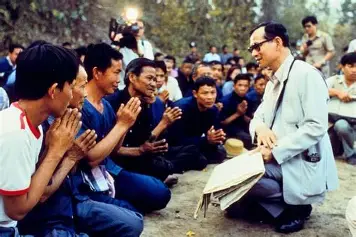
Until 2016 most Thais had only known one king. King Bhumibol Adulyadej, Rama IX (reigned 1946–2016).
You may notice that, in this country, allegiance is to an individual and not an organisation.
If you respect your boss, you will put in that extra effort to help him out with a report to his superiors. You do it for him, not the company. The Thais think of their king in this personal way.
Back to Weelai
So where does that leave someone like Weelai?
Weelai could hold her own in any political discussion and had extensive knowledge of the systems of government in both democratic and non-democratic countries. That alone made her untypical.
Most Thais have little knowledge of their history and feel ill at ease when debating even the least contentious of topics. They are happier chatting and exchanging everyday gossip with their friends and neighbours.
I first met Weelai when she was on a panel debating the American political system. Her understanding of how the senate and congress worked, her insight into the roles of lobbyists and pressure groups, and her comprehension of how presidential elections were lost or won was remarkable.
Although argument is normally anathema to the Thai, she gained great respect through her discussions on international forums, putting forward alternative views.
Her familiarity with western ways was not only obvious in her lectures on other political systems but also became apparent when discussing or explaining certain concepts that are generally regarded differently in Thai and western societies.
She understood the Westerner and appreciated the cultural clashes that could occur. Her opinions on how Thais and farangs could find solutions to these frustrations were always well thought out and explained.
She tried to encourage the farang to talk less loudly and not be so assertive or “pushy” while explaining to her fellow Thais that giving honest direct answers to farangs is what they expect.
Margaret Mead

But a little naive in not checking the facts her team gave her.
She quoted Margaret Mead’s experience where the Samoans gave the anthropologist the answers they thought would impress her rather than the correct facts she needed for her research. Weelai put it plainly that foreigners want the truth and don’t mind if it sometimes hurts.
Scores of Westerners went to her with their disappointments and frustrations. She became a sort of “agony aunt” for expats in the area where she lived.
Even after her retirement, she was referred to as Ajarn Wee or Ajarn Weelai. Closer Thai friends would call her Pee Wee. (Pee being the respectful word for an elder.) Nobody else called her Weelai. As a farang, I always called her Ajarn Weelai.
The shortened form that her Thai colleagues used would not have sounded right coming from a farang and, anyway, I could never stop myself from thinking what the words “pee” and “wee” would conjure up to an English listener.
There was always a sense of aloofness around her. Her knowledge and intellect made some Thais rather jealous of her. It’s not easy to spot, but if you are watchful in your travels, you will recognise this Thai characteristic.
A word on jealousy – it’s not just Thai
There is a little of this Thai jealousy to be found within the expat population. A vociferous minority recognise they have more money than ordinary Thais but resent not being accepted into Thai social circles.
The majority integrate well because they take the trouble to understand (if not fully agree with) Thai lifestyle and culture.
Money talks in some situations, but when Thais sense a colonial attitude, that foreigner won’t gain entry to Thai life. This minority spend most of their time in moobaans where there are a large number of foreign residents. In a way, they create their own ghettoes away from the real Thai communities.

There are also foreigners who, through no fault of their own, have fallen on hard times, losing their money to scammers and fraudsters. Not all these crooks are Thai.
A significant number of foreign businessmen play on their naivety and take advantage of a captive market of people who speak little Thai and become vulnerable victims to those they believe can be trusted because they are western.
Pattaya and Phuket particularly have this reputation.
Some Thais are a little jealous of foreigners as they are perceived, often wrongly, as being richer than they are. Some can be envious and want to emulate them. The hi-society people want the same as Westerners and can be seen flaunting their Rolex watches and Prada bags (copies or not).
One of the reasons that dual pricing for foreigners has taken such a hold is because of this intrinsic jealousy. The ever-present smile camouflages the resentment and xenophobia some Thais feel.
Now, let’s talk about family – the real heartbeat of Thailand
Thailand is very family-oriented. Members stay close throughout their lives. It is a people-conscious society. A Thai family sees itself as part of the local community and ready to help others in the neighbourhood – whether that is money, food, or rallying round when needed.
Nam jai, giving and receiving of gifts and favours, is an instinctive part of Thai life. “Nam” means water and it is this idea of a “freely flowing” substance coming from the heart (jai) that is the origin of the expression nam jai.
It is a money-conscious society because money is a means of gaining esteem and prestige in Thailand. It can be employed to show off or it can be used to indicate where you stand in the community.
It is the resource that allows much reciprocal giving. The rich will give donations to local and national wats as well as sponsoring local amenities. Even those on low wages make donations to the wat and local projects. It is expected that they do so and Thais are happy to contribute to their community. It is a habitual response.
A record is made of all donations – money is not given anonymously as much as in the West – and usually the list is read out over the local loudspeaker system later in the day. Ajarn Weelai, 1000 baht; Khun Goong, 50 baht; Chang Bancha, 100 baht. It would be unthinkable not to give 40 or 100 baht if a colleague in your office, or a member of his family, died.
From what I have witnessed, it is an unconscious response rather than giving in to any peer pressure.
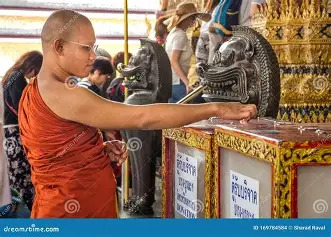
A Typical Thai Household Budget
Low-paid workers, as a rule of thumb, budget on the basis of one-third for food, one-third for accommodation, and one-third for petrol for travelling to and from work.
Forty baht per meal spent at a stall on the side of the road three times a day; renting a one-room bed-sit with a squat toilet; and petrol for the motorbike which is on hire purchase or on loan from the family. Borrowing money from friends or family to make ends meet towards the end of the month is not unusual.
During periods of austerity in the West, such “payday” loans have become commonplace. In Thailand it has always been a popular way of getting by until next payday.
Getting to know ordinary Thais changes everything
Getting to know the ordinary Thai will give you a good insight into Thai life and probably change some of the clichéd perceptions of Thailand. You will be taking a second look at the culture and lifestyle.
Talking to Thais, you will learn that for most families their parents and grandparents came from a poor background. They are therefore acutely aware, even now, of the need to have money for survival. Saving for the future is not a priority.
Buddhism teaches that life is not permanent. This may account for the typically Thai attitude of not worrying about tomorrow. Family and friends will always be there to help if needed.
You will find yourself being introduced to aunts, uncles, cousins, and nieces, when in fact they are just friends, close enough to be regarded as family. In time, you may find Thais beginning to accept you. They will start using your first name instead of farang or respectfully calling you lung (uncle) or pa.
It will depend on how far you have absorbed the culture and way of life of the ordinary Thai. Although they will never totally accept you – their Thainess and passionate patriotism will prevent that – the relationship will be warmer.
Normally, you will have to make the first move in making friends. Cracking a joke works well. Just as you would if you walked into the bar of a pub in the UK and did not know anyone.
We do not have that same extended family concept in the West. It is, however, interesting that we now see this in South Africa where fellow whites look after whites who have fallen on bad times. They treat them as if they are one of the family. Thailand has always had that concern for others.
Family comes before business – always
The Thai will always put family before business. In the workplace, there would be no problem in attending to family matters ahead of achieving a business deadline. During the Thai New Year, it is perfectly acceptable for staff to take a few extra days off to visit relatives.
Management do not normally give it a second thought. However, an architect who also owned a building firm once confided in me that it played havoc with his building schedules and that he always had headaches about missed deadlines and penalty clauses being imposed against him.
Many activities are centred on the family unit. Weddings, funerals, the arrival of a new baby, a daughter’s graduation, a job promotion, a house-warming. Families will get together whenever they can and keep in contact. Mobile phones are widely used to communicate with one another.
Your boss won’t raise an eyebrow if you’re taking a short call from a relative or friend during a meeting or an extended call when you’re at your desk. It can come as a culture shock to newly arrived expat workers.
A note on women, family bonds, and marriage
A woman has a stronger bond to her family than to her husband or partner. Her bloodline is more important and relevant to her. Female liberation, women’s lib, is not strong in Thailand. Her duty is to her parents and to the family in which she was brought up.
A husband comes second; you marry the family not the bride in Thailand. It is the man who is joining the girl’s family and not the other way round.
I heard Khun Somrak say of her husband, “Why can’t he understand that my mum and dad supported and cared for me without question as I was growing up? Now it’s my turn to repay that kindness. As a member of the family, he must now help me look after them.”
I say “must” but I really mean “want to”. It is my duty and his. That is what I was brought up to believe.
Somrak wants her farang husband to consider himself part of her family. He will never be fully accepted – he is not a blood relative or a naturalised Thai – but she wants him involved with her family.
There are many similarities between Thai lifestyle and that of China and other parts of the Far East. The burden of who looks after the family is not, however, one of them. In China, it is the son who has responsibility for his aged parents when they grow old.
The “one child family” rule, which effectively encouraged the abortion or abandonment or non-registration of female babies, led to couples waiting until they had their first male child before deciding to have no more children.
In Thailand, providing for one’s relatives can sometimes involve a girl moving from home to one of the larger cities. She will then typically send a regular and relatively large part of her earnings back to her parents. Mostly the work will be legitimate but it can be much less savoury.
Prostitution does not have the same stigma in Thailand as elsewhere. To save face, the work may be described as being in the hospitality industry or working as a cashier in a bar. The truth is understood but not mentioned. What is key is that the daughter is dutifully providing for family.
Living together, staying together
Relatives, particularly the elderly, will live on a single plot of land with the rest of the family. Newly-weds will normally have a house of their own within the compound or very close by.
Despite being independent and wanting their own way, Thais have a passion for doing things together. Community functions and religious festivals at the wat are the common socialising grounds.
I saw this apparent enigma at a funeral. Everyone was doing what they thought and wanted to do, showing their independence. Then the funeral director came over to change it, usually ever so slightly. The Thai will accept that because the passion for doing things overrules their independent streak.
Paying one’s last respects to the deceased is a duty that Thais willingly engage in. It is not so much an obligation as a natural cultural response to living in the community.
Getting on with people is preferred to disputes. Thais believe that it is always better to create bonds of friendship and gain useful networking contacts. Whom you know can be useful in this country.
I recall Suda telling me about a job interview she had in Bangkok.
Interviewer: Who is your boss?
Suda: Khun Manat ka.
Interviewer: Good. I know him.
That was the only question she was asked. She got the job. Who you know beats what you know in Thailand. Position in the elite hierarchy overrules meritocracy.
On friends, enemies, and social circles
Annoy someone in Thailand and you make an enemy of his friends too; befriend him and you may well be invited into his social circle, his phak puak. You will enjoy life more if you participate in neighbourhood events with the locals themselves.
Your experiences will be very different from those you may enjoy in a formal expats club, by only participating in expat events, or living in a predominantly foreign-dominated moobaan (housing estate, project). You will feel more a part of Thailand.
Thais are outgoing and live in groups. They could never survive on a deserted island. They need people around them. A Thai would never say, “I need my personal space.”
Even Ajarn Weelai, who lived alone and immersed herself in her hobbies, enthusiastically engages in community activities organised by the wat or other local groups. She would never miss a religious festival.
Merit, money, and giving
In some provinces, it is traditional at parties for relatives, friends, work colleagues, and neighbours to give an envelope containing money to the host. Although the gifts are given to the host as gratitude for his hospitality (in western eyes), Thais regard it as a show of merit (tambon in Thai) on the part of the guests.
Buddhists think of merit as achieved by good deeds, so by giving a gift to the host you are making merit for yourself and improving your karma. At funerals, any merit you gain is transferred to the deceased.
Similarly, at most tambonbaans (house-warmings) a sealed envelope containing some money is handed to the homeowners during the monks’ blessing. This gives the donor merit while cash is always welcome when you move into a new home.
The owners will give their own cash envelopes to the monks as a token of their own merit. This merit ceremony does not always take place when the new house is bought. If funds are short, it will be postponed, perhaps for a year, until money for a decent party is available.
Wedding parties can similarly be delayed for this reason. Thais like occasions to be fun and enjoyable events with lots of sanuk. They’ll wait to make sure everyone is having a good time.
Greng jai – not imposing
Thais pop in to see friends occasionally but arranging a soiree or dinner party at home that is then reciprocated, is not the norm. If you turn up to see someone, food will be offered but guests usually politely decline. This is the concept of greng jai, not imposing oneself on others.
…arranging a soiree or dinner party at home that is then reciprocated is not the norm.
If a more formal dinner with friends is contemplated, then the usual choice is to meet at a restaurant. If a Thai has farang friends, it may be that there is some embarrassment that the Thai home is not up to the standards of a more expensive foreign home. Eating at a restaurant solves the problem for the Thai.
As a rule, the senior person, considered to be the richest, picks up the tab.
If the gathering is one that is informally organised within the neighbourhood, then it is okay and customary to bring some contribution of food and drink. Even if just visiting someone, it is usual to take a small gift of fruit or some other small gift.
Caring and sharing is the established custom. Thais prefer socialising in larger numbers and meeting with other people in the community. They are happier enjoying some sanuk with their neighbours. It makes for a cohesive and strong community spirit within society.
The word ‘friend’ means something different in Thailand
They seldom use the word colleague or acquaintance, though those words do exist in the language, preferring to use the word friend. “She’s my friend” can often just mean someone who works in the same company as she does. She may only have spoken to her a few times. The use of “friend” makes bonding easier.
There is a strong sense of comradeship, camaraderie, within all Thai groups. Keeping in touch with old school chums, people you worked with long ago, and university contacts comes naturally to a Thai. More so than in the West.

When Seri died at the young age of 42, twenty of her year group, who had graduated with her many years ago, travelled miles to be at her funeral. Taking an overnight train or flying up-country from Bangkok, necessitating a few days off work, did not seem out of the ordinary either to them or to their employers.
A collection was made for the family and handed over by the eldest in the group. They helped the family in other ways too. They copied a photo of her in her university robes from a Facebook page and framed it so that it could be carried at the head of the funeral procession.
At the cremation, they formed a circle around the coffin, draped with the university flag, and sang the college anthem. Generally, we see the Thai as rather stoical and not showing emotion. But singing this farewell to their former classmate brought a few tears to many eyes.
It is normal, of course, to comfort people in that situation so that they regain their composure. And that happened here. What was different was that half an hour later everyone in the group was laughing and joking. In the West, there may be smiles and light chatter but not laughter and gaiety.
This is the Thai way of responding and getting over the grief they felt. A big cultural difference.
Relationships, introductions, and what they mean
When a girl introduces a fiancé or boyfriend to her parents, she is in effect saying that this is her permanent partner and not a casual relationship. It’s not so much getting family approval as making her family and circle of friends and acquaintances aware that the relationship is serious.
In western cultures, it is often accepted that friendships can still be kept even after a relationship has ended. That can happen here but it is not usual. They would, of course, say what politeness requires and smile. Help would be given if help were ever needed. An ex-husband and wife would most likely attend the former spouse’s funeral.
Sin sot – the dowry
The Thai practice of a man giving a dowry (sin sot) to his fiancée’s parents is a way of repaying the family for bringing up the daughter and to compensate for any loss of the daughter’s income after marriage. It is still common in all but the poorest of families and, even on those occasions, token payments are made depending on ability to pay.
Although a great show is made of presenting the money, it is often discreetly given back to the bride and groom for their own use in their life together. Divorced women, widows, and those with children do not technically attract sin sot. Foreigners are usually not told of this exception.
Farangs may perceive it as a form of buying the girl, a bride price. Thais do not see it like that. The literal translation of “bride price” in Thai is “mother’s milk” which is a reference to a mother’s caring for her infant after birth. The sin sot is viewed as a repayment for that motherly love.
If the parents are not keen on the boyfriend, they never say so. They push the price up so that he gets the message. If the woman is that much in love, she will accept the parents’ decision now but probably elope and leave the family home and village later.
The more you understand the Thais and Thailand, the more you appreciate that Westerners and Thais think differently about money matters.
Is he buying you? The girl will likely reply: Certainly not. My husband should be showing nam jai to my parents. A Thai would see it as his duty to be generous to my mother for loving me and feeding me when I was a baby. In Thai, we have the expression “the husband paying for mother’s milk.”
A little western history for context
In the past, it was common practice in the West for the bride’s family to pay a dowry to the husband. This was partly a prepayment of what the daughter would have inherited when her parents died. More importantly, it was a sum of money to ensure that the new couple would be financially secure.
It was vital too that the daughter’s social status should be upheld, keeping the family’s position in the class structure intact.
Victorian families in England initiated arranged marriages where the basis of the union was money, power, and keeping the lady in the manner to which she had become accustomed.
Class and hierarchy were being reinforced by ensuring that the couple were sufficiently well off to participate in the society in which they had been brought up.
Love had little to do with it. The practice was not limited to the UK. It was common in other countries in the world, particularly those in Europe. Sin sot and the strong family tradition are the parallels in Thailand.
In Thai marriages today, both the parents and the couple see matrimony as a commitment. The amount of the dowry, and sometimes the marriage itself, is often negotiated, sometimes by a go-between, the mae sue. Thais take a dim view if a girl’s parents try unreasonably to inflate the amount.
If a farang takes good advice and knows the ground rules, he can avoid any unscrupulous swindling when a family has an incorrect assumption of the groom’s wealth.
There is still some pressure for a girl to marry well, wealth not love being paramount.
However, Thai parents are unlikely today to choose their daughter’s husband. They might well have done so a few decades ago. A Thai lady’s priority in seeking a partner is to find someone who will be caring to her and her family.
Bunkhun – the debt of kindness
A Thai husband will continue to support his wife’s family after the wedding has been celebrated and the dowry paid. He will be happy to do so. He would lose face if he did not. Giving is not all one-way. It is reciprocal. The family will help the new couple whenever it can.
Thais have this strong sense of giving and sharing. The husband will look after his own family, following this tradition, though not to the same extent. Favours are always returned in Thailand. It is an expected part of the culture.
An elder colleague in an office environment will look after a younger member of the team. The kindness will be repaid at every opportunity. The idea is called bunkhun in Thai.
Freshers in their first university term are assigned a “senior” who will show them the ropes. The relationship continues throughout the students’ time in college. At faculty reunions, the student will seek out and wai his “senior.”
Looking after the old – a family duty
There are very few old people’s homes in the country. The Thais do not feel comfortable with that alternative to looking after the elderly. It is anyway expensive for them. Farangs look at it differently.
The Japanese too have no difficulty in accepting the retirement home idea and willingly choose Thailand as one of their favourite destinations for that purpose. There are several in the northern provinces of the country.
For the Thai, looking after the aged is a family and not a state responsibility. Paying a private institution to look after old granny is not a common choice.
It may be that a private hospital or nursing home could provide good round-the-clock care but the Thai would generally consider sending a relation there as avoiding family responsibilities.
The custom is for family elders to stay at home and be looked after until their final days.
If anyone, old or young, is hospitalised in Thailand, it is not unusual for a family member to stay overnight with the patient. It provides companionship and comfort. The hospital authorities welcome the provision of more intimate care and readily cater for the overnight stays by providing a foldaway bed and other facilities.
It helps the patient to recover more quickly and has the benefit of someone being with the patient most of the time. Nurses still check the patient regularly.

Dta Sompet – a small story of duty
You can set your watch by him. It is six o’clock. The national anthem is now striking up. Dta Sompet, who is 83 years old, is pedalling his cycle the few hundred metres to his younger daughter’s small village shop, as he has done without fail every evening for the last three years.
He will spend the night there after the store is properly locked and bolted, leaving his wife, eldest daughter, son-in-law, and grand-daughter at home.
His daughter, Khun Fai, who divorced several years ago, now lives alone. It is his routine to provide security for her. Helping within the family group is an overriding factor in his thinking. Filial duty is being unquestionably repaid. Blood is certainly thicker than water.
The darker side – when nam jai is missing
As everywhere else in the world, Thai families have their black sheep. Errant younger brothers can become addicted to drugs, be in constant trouble with the police, or be unable to hold down a job. As a son of the family, he is never turned away and every year he will get a birthday present from his elder sister.
She receives no present from him on her birthday and none is expected. She is older and is expected to look after him.
Not all Thais have this caring nam jai. Not telling someone when a relative or friend has died does sadly happen. The thought of caring for others may be absent when greed or jealousy is involved. An illness or death in the family may be kept quiet so that not all the relatives will share in any eventual inheritance.
I know of only two examples.
A brother refused to take his older sister to hospital, claiming he could not drive because it was dark and his eyesight was not good. He went on to play a game of poker with his mates in a poorly lit bar. Lack of nam jai is rare but is not absent from Thai life.
This stubbornness is not acceptable behaviour but some people are too thick-skinned to realise it. Thais do have a fiercely independent, perhaps even selfish, streak sometimes. You may notice that Thais give excuses such as these when they wish not to do something.
Family loyalty trumps honesty
Family loyalty trumps honesty most of the time. Cheating and even corruption will be covered up if a family member is implicated. It is acknowledged that you will lie to avoid getting a relative into difficulties.
A mother will go to the police station with her 28-year-old son, arrested for riding a motorcycle without lights. She will be pleading his case. He will be sitting there playing games on his mobile phone.
A person’s allegiance is, first and foremost, to family. It will take precedence over loyalty to the company you work for or any obligations you may have for your job.
The exception is where you feel a personal loyalty to your boss as an individual. It would not be unusual to work overtime or at weekends, unpaid, to help a superior finish a task or meet a deadline. But it is a commitment to the person not the organisation.
A matriarchal streak
Thailand is to a certain extent matriarchal. Women can influence behind the scenes, however deferential they may appear to be towards the male gender in other ways. The man may look macho but it is the woman who wears the trousers.
The Thai language can give you clues showing how important Thais consider the matriarchal tradition. The word for a military commander, for example, literally translates as “mother of force” – showing that, even in the army, strength and military might is seen as a feminine characteristic!
The woman is in charge of the home and handles the finances. In most families, it is the woman who is responsible for the children’s discipline. There are exceptions, sometimes violent, but fathers typically prefer not to get involved.
Children – discipline the Thai way
Discipline within the family can appear lax to the western eye. Children come across as being spoilt and allowed to have their own way. Thais seem to have difficulty balancing caring for a child with occasionally having to say no.
They take a more laissez-faire attitude to bringing up children than other nationalities. It is, once more, the influence of mai pen rai and avoiding arguments.
It was a very embarrassing moment for the English couple who had invited Dao and her six-year-old son to help them celebrate their wedding anniversary at a local restaurant. They had met Dao on holiday. It was their first time in Thailand and they appreciated her showing them around.
Boon, her son, had asked for an orange juice with ice. Then he wanted more ice. His glass was filled to the brim. Dao tried to explain that the drink would spill over if more ice were added. He was having none of that logic. He wanted strawberries, then refused to eat them. Dao offered them around the table but he snatched them back and kicked over two chairs in a fit of temper.
Dao rang her husband and asked him to come to the restaurant but he had gone fishing with friends. She dragged Boon to the toilets where he could be heard screaming and shouting. When they returned ten minutes later, there were bite marks on Dao’s right ankle. Mosquito bites, she said.
The Thais at the restaurant did not appear especially surprised at the chairs being upturned and the screaming. It rather spoilt Pat and Barry’s special occasion.
A contrast with French families
A contrast with French families
French families are generally stricter with their children. They believe in enforcing manners at an early stage. They will shout and even slap to ensure that the need for good manners is understood.
Children are taught both at home and at school to be polite with strangers, to behave correctly at table, and not always insist on having their own way. They are expected to do as they are told.
In twinning exchanges between France and England, for example, you will find that at the formal functions, the French have separate tables for the children. The French do not involve their children in adult activities or conversation. They are meant to be seen and not heard.
Thai families would not segregate the children. To them, one family means one family.
When the English return the hospitality the following year, adults and children sit at the same table. Thai families would do the same. For them, it is important that the family be kept together.
Some would wonder if there are links between how children are raised, their bad behaviour, and the adolescent and adult crime rates in various countries.
Prisons and rehabilitation – a different atmosphere
The apparent and stated emphasis in juvenile correction centres in Thailand is on rehabilitation rather than on punishment. Sometimes it succeeds; sometimes it does not. The more street-wise kids are practised in taking advantage of the enlightened but soft approach.
Although conditions in penal institutions can be harsh, discipline is not rigorously enforced in junior detention centres. Thais dislike creating conflict. You will see smiles in Thai prisons, at times you’ll hear laughter and humour from inmates and guards. Video calls on WhatsApp are allowed.
But you won’t see individual televisions in the cells, there is no choice of meals, and toilet facilities are primitive. Prisons are not hotels. Some conditions may appear tough but the atmosphere is not an unhappy, uncaring one.
The village headman and community glue together
Daily announcements by the village headman over the village loudspeaker system show how concerned Thais are for those in the community. Regular information is given on school events, children’s activities, and hobbies for the elderly. People are reminded that there is a free lunch for pensioners or that a new fitness class is about to start.
The headman of each village, the pooyaibaan, is elected by the community and is responsible for the smooth running of his tambon (district). His official functions include the maintenance of voting and resident registers and the resolution of minor disputes.
He is also an important part of the communications loop between the district government, the provincial government, and ultimately the national government — the eyes and ears of what is going on locally in the community.
China has a very similar system with its neighbourhood and village committees.
The pooyaibaan in Thailand is pro-active in local activities. The more dynamic communities are those with a dedicated and trusted village headman. Everyone knows and respects him. He knows everyone in the area. Thailand, as a country, runs smoothly through its community structure.
Thailand has a history of coups and political unrest but an uncanny ability to run administrative systems smoothly throughout those periods. Even when a government is removed from office, it is business as usual.
If you had no access to the news, you would wonder if any coup had taken place. People still smile and enjoy themselves.
Working together – the everyday reality
People help each other in many ways. Although a drainage canal is local authority property, homeowners will make repairs to it if it is on adjoining land and doing so would benefit the neighbours.
For a more major cleaning, a task force may be organised and spend a morning working voluntarily together. A party usually follows.
In one village, a compost heap had been established with everyone bringing their garden and farm waste. A year later, the composted material was shared out. Community participation and thoughtfulness for others, greng jai, can be quite strong.
If this idea of cooperation was developed more widely, it might alleviate the seasonal problem of smog in some parts of Thailand. In the North, particularly, the practice of slash and burn, where fields are burned prior to the next crop, regularly causes breathing difficulties and hospitalisation. Composting or ploughing-in after harvest might be better.
Surplus fruit or vegetables from your garden are shared with those living near you. It is more than a gesture; it is a standard response to which Thais would never give a second thought. If a villager is not at home, the food is left in a parcel on the gatepost. This is nam jai in action, caring and sharing.
Giving is reciprocal in Thailand. If a gift is given, you will receive something in return at some other time. The Thais are somewhat particular in keeping to this rule of give and take which they call sam nuk bun kun. Not to respond to a gift would be unthinkable.
They don’t want to be in your debt and want to share their nam jai with you. You get a feel for how often and how much.
A final thought – community over contract
Community interests can overrule laws and regulations. Agreements can go by the board. What is considered best for the family or community will always take precedence over any binding contract. Village elders decide how the local community runs.
It is usually successful as the more snobby members find themselves held back in public meetings by a general consensus of those keen to see the village and community develop.
Even with a discussion on family and community, we see how hierarchy, face, cheating, religion, and respect are all inter-related.
For a shorter though less detailed link on the problems of marriage in Thailand and how to deal with them, check out this internal link.
https://www.understanding-thailand.com/you-marry-family-in-thailand/
The content and final editing remain my own.