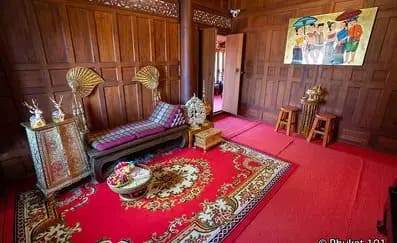
Everyday examples of Mai Pen Rai.
Give me grace to accept with serenity
the things that cannot be changed,
Courage to change the things
which should be changed,
Living one day at a time,
Enjoying one moment at a time. (The Serenity Prayer, Reinhold Niebuhr)
You will hear the phrase “mai pen rai” every day in Thailand. The glossaries in most tourist guides define the Thai expression as “never mind.” But it actually has many other meanings. It is a Thai mind-set that creates a hassle-free outlook on life. Why worry or get stressed about things that you cannot control and are not that important? That is the basis of the philosophy of mai pen rai.
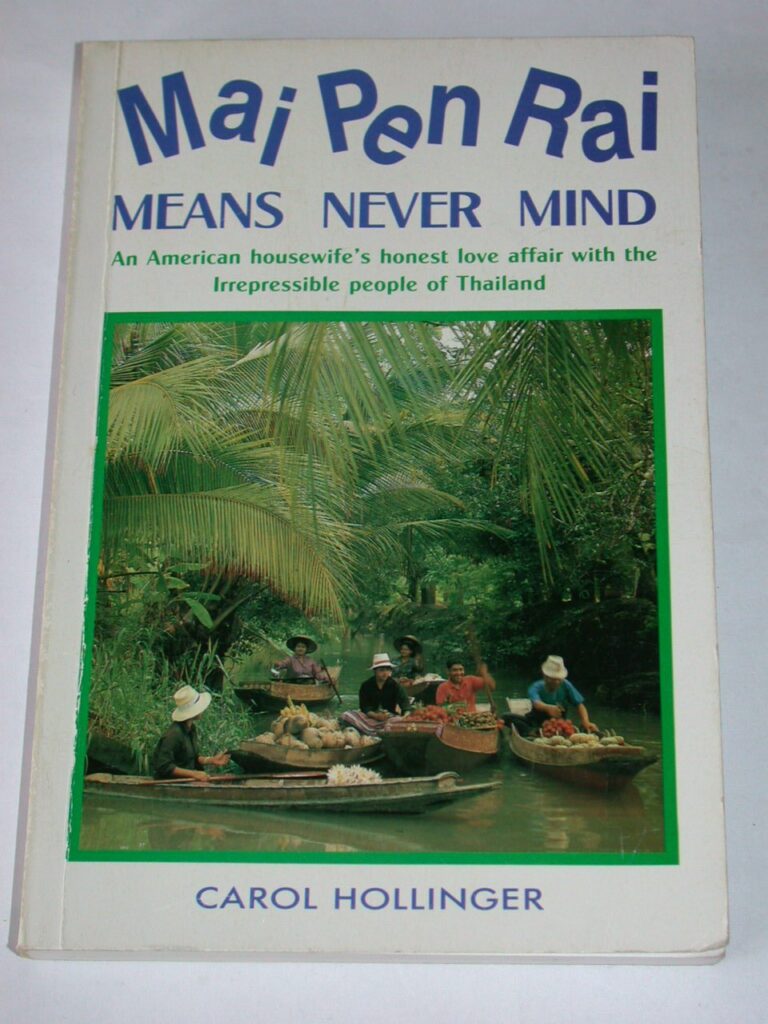
Carol Hollinger unfortunately died before her book was released for publication. It’s widely available, particularly in airport bookshops. It’s not available as an eBook.
A double blow for Matt Owens Rees as we intended to work together on the Thai concept of Face.
Let’s look at some examples from daily life.
You bump into someone in the market and excuse yourself by saying “sorry.”
The response? Mai pen rai krap. That’s okay. It doesn’t matter.
You thank a passer-by for giving you directions.
The response? Mai pen rai krap. This time it means something like “my pleasure” or “you’re welcome.” The French would say “de rien,” the Germans, “bitte schön,” and the Italians, “prego.”
You are discussing some alterations to a building plan and the architect does not see why you want an extra shower room with access from the garden.
His response? Mai pen rai krap.
You can’t understand why the architect is telling you that it does not matter. It’s what you want him to do and you are, after all, paying his fees.
You explain your reasoning but get no immediate commitment for change. His initial reaction is not to problem-solve. Thais dislike dealing with problems. Usually, the response is to ignore or treat as insignificant. He is looking for compromise and flexibility, or to see if you will back down. As a foreigner, you are surprised he is not addressing your concerns.
It is better to pootwan, sweet talk, and be patient rather than to try logic and reason. Smile and say you still think it may be a good idea. Praise the work he has already completed. You can always raise the point again if it is not done. What the architect meant was that he did not consider it important enough to have been in his original planning.
He will change it discretely and without losing face if that is what you really want. It’s not that it does not matter to him. He values your custom. He is saying that you are making an issue out of something that he personally thought wasn’t that important.
A few days later, the plans will be altered and you will get the extra shower room that you requested. He won’t comment further or apologise, to do so would be a loss of face. Thais will cover up rather than suggest a solution or admit an error.
Thais feel expats can be rather abrupt when speaking and are too uncompromising and formal. The Thai way is to be less direct and not so forceful in conversation. Thailand’s Mai pen rai is more an attitude of mind related to the relaxed lifestyle than a mere set of words.
It is a way of thinking that is consistent with the Thai way of life and their aversion to having to deal with arguments or quarrels. Life is for living; be happy and avoid stress.
Happiness and fun (sanuk) are their watchwords. The word “serious” does not exist in the vocabulary of most Thais.
A carpenter had built a small tie-rack in the master bedroom wardrobe. The corners were not secure. You could move them from side to side. Rather than get the oft-quoted face-saving excuse, “not finished yet,” I asked if the rack was now complete. He said it was. I slid it out and moved the joints up and down showing it obviously was not.
The carpenter said he would fix the piece. It took two days for him to hammer in a few nails and return to me. He had not made proper Mortise and Tenon joints but at least it no longer wobbled. I had not made the situation one of conflict but had made him correct his work. He minimized saving face by taking two days to do the job to show how concerned he was to provide good service and get the tie-rack “repaired.”
If you have ever had a house built in Thailand you will know that electrical and plumbing connections are often loose, surfaces for painting are not cleaned and made smooth, and more than the recommended amount of water is added to paint before applying. Grouting is not to western standards. If it looks okay and passes an initial inspection by quality control and the customer, then all is fine.
It does not matter that there will be problems in the future. Mai pen rai supersedes perfection. There are more examples in my book, A Thailand Diary, and on the independent website, http://www.coolthaihouse.com
You book a table in your local restaurant but, when you arrive, you find they have stopped serving and all the kitchen staff have gone home early. Will you be angry or annoyed, or will you be Thai and say Mai pen rai krap? You won’t die of hunger while trying to discover another eating-house. You may even find the next one will become your favourite place for a meal.
Mai pen rai is about being as easy-going, calm, and patient as you can.
You will find the Thais very tolerant until they feel they can take no more loss of Face. They will then smile, may well walk away, but seldom will they continue to argue the point. Only as a last resort or under provocation will they get angry.
The smile will still be there but you won’t detect the the pent up anger. You won’t see it coming. If they get violent, there will be no warning sign. To avoid the situation, stay calm, keep your voice down, and don’t come across as wanting to perpetuate the row.
Walking away may feel like surrender in the West, not standing up for your principles. In Thailand, it is the normal way out of avoiding further quarrels. Thais don’t impose on other people. The term in Thai is greng jai – a feeling of compassion for your fellows. It is time to politely move on. Discretion is the better part of valour.
Keeping passions bottled-up is not always a good idea but it is a Thai characteristic. In an argument, the Irish and the Italians, for example, are more likely to release their bitterness immediately and get it out of their system – many would say that doing so is healthier than keeping the anger pent up inside.
Some time ago, Goong, our cashier at the photo shop, was under a lot of pressure in her job. Staff shortages meant she was being overloaded with work, with little help or support from management. She was blamed for computer problems that were not even her responsibility. Goong did what all Thais do and tried to ignore the situation and its pressures – keep calm, don’t let it get to you. Mai pen rai is a coping mechanism.
But it did get to her. She was admitted to a psychiatric hospital for a week. Drugs helped her recovery. Compassion and understanding from her colleagues helped more. Keeping her feelings to herself and trying to control her emotions, as all Thais do, had not been a good idea.
The store doesn’t have what you are looking for. The sales staff may possibly ask if they can order the item for you but are more likely to say that they don’t have the item in stock and politely smile. It may be that the item is in the warehouse and it is not convenient to fetch it right now. Thai customers would accept that by smiling and adopting the mai pen rai attitude. The sales staff’s reaction merely being a “white” lie.
We look at the situation differently. Our response should be to smile back, say mai pen rai krap, and try another shop, however disappointed we may feel. Let it go. It’s a point of view that Westerners have difficulty in grasping. Even after more than a decade in Thailand, mai pen rai can still surprise and frustrate me.
Bureaucracy is the same the world over. Go to any government department, take all the documentation that has been requested, wait patiently in a queue, and expect to be passed from one official to another. When told you need two further photocopies of your identity card, just say mai pen rai and stroll round to the photocopy shop.
Here, of course, mai pen rai means, “okay. I’ll do that.” Showing anger or complaining won’t work. Thais consider shows of irritation a character failing. Adopting the same attitude as they do, and taking it as inconvenient but not that vital, is probably the better strategy. Just re-join the line. On a follow-up visit, the extra requirement may well be something entirely different anyway.
Not easy for a foreigner, but try not to show your emotions. Be like the Thai.
Much depends on whom you see or which government office you attend. Rules can be interpreted with great flexibility in Thailand. They can change by the day. Try not to let bureaucracies get to you. Aim not to take the frustrations to heart. It is a bit annoying but does it really matter? Mai pen rai is your defense mechanism in Thailand as elsewhere.
Thais more often than not avoid clashes and disagreements by saying mai pen rai and walking away. They don’t outwardly show their frustrations; they have been brought up to keep a low profile and keep emotions to themselves: they camouflage their feelings so that you do not know their inner emotions particularly if they are anti-social.
Thais do not let people get the better of them. Their motto is: don’t let the bastards grind you down.
Thais have zero inner personal respect for petty bureaucracy, a dislike of the “job’s-worth” official who plays everything by the book and ignores common sense solutions. Inside, the Thai may be seething with anger. Outwardly, he takes the mai pen rai view and accepts it because he feels it’s outside his control. Contrast that with the total respect he has for family and monarchy. That matters very much to Thais.
They can be very indifferent and inconsiderate in actions that they believe to be unimportant. Motorcyclists routinely pull out of side roads without looking, seemingly unaware of the danger. This indifference is a form of mai pen rai. Do they really believe that providence and not their lack of riding skills will determine the timing of any fatal accident?
On Thai roads, it is also possible that the attitude is linked to the Thai belief in individual freedom to do what one likes.
Watch workers cleaning a drainage canal and note how they just leave the debris on the side of the bank. Mai pen rai is well established in their philosophy. What is the point of cleaning up? The weather and the passage of time will eventually rot the waste material and compost it into the soil.
Quality assurance is a tricky job in Thailand.
QA engineers have to keep a distance between themselves and the workers as they are aware of the tendency for poor workmanship or mistakes not to be taken seriously. In construction projects particularly, standards are much lower than in the West. You will find exceptions but most craftsmen don’t strive to complete jobs properly. Corners will be cut.
QA men will, on not approving some outside paintwork, spray prominent “X’ marks on the walls to ensure the whole areas gets a second coat and not just a quick repair to a few spots. They will then walk away. They won’t discuss or reason with the workers.
There must be no argument and no loss of face. The workers’ practices are culturally accepted. But the engineers must make a stand against Thailand’s mai pen rai culture if they are to protect their customers’ interests.
Ordinary Thais are very down-to-earth and are expert in determining whether something is essential or not. A schoolgirl, with maybe only one school uniform to her name, won’t adopt a mai pen rai attitude when considering whether to clean and iron her uniform each day. For her to be tidy and smart at school is important to her.
Appearance and dress is of great significance to all Thais, a lesson their families instill in them from an early age. Schoolboys are equally fastidious about their uniforms even if it is mum who ends up doing the ironing.
There is a mai pen rai attitude in the workplace too. Festivals can be more important than meeting a deadline. The work can always be finished tomorrow. The partying cannot possibly be postponed.
The three official days of the Songkran holiday in April, marking the Thai New Year, are often extended to a week. Construction workers will take the opportunity to visit family up-country. They may decide not to return. Or, they may return a year later as if there had been no period of absence. Neither worker nor employer would be surprised.
In the West, workers and employers would not expect the post to be kept open for such a long time. A job is seen as a means of getting money for short-term needs and not a way of life. If they are able to, Thais move to new employment when they are bored. They would still keep in contact with ex-colleagues but there is no sense of group loyalty that would make them stay with a single employer.
The loyalty expected in the master / servant relationship in, for example, upper class households in Victorian Britain would be anathema to the Thai. In England, below stairs staff would serve for life and that obligation would be reciprocated by a beneficent and protective employer until the servants retired and even then they would be given some support.
Thai staff work without question to comply with their positions in the class system but are not loyal to the same degree. Staying with a sole employer or company is unusual in Thailand.
Spending quality time with family is a better option than getting back to work on a building site on time. We should work to live and not live to work. The Thai work ethic includes allowing employees time off to attend family events, merit ceremonies, and to organise personal business. The worker may not always be paid but the practice is accepted and customary.
Office staff will think nothing of having a break to make garlands and decorations for an office or private party. There is always a sensible work and leisure balance. They are not being lazy. The work will be done eventually if staff think it’s really necessary. When asked why he had left a well paid job, a Thai replied, “It was not fun anymore.”
All day without water. Fortunately, I had had an early morning shower. It was beginning to get inconvenient. I wanted to water the garden, the car needed a clean, and the toilets could not be flushed. I had checked all the plumbing and all seemed well. Nearby houses evidently had a supply. I knew I had paid the monthly water bill so I should not have been cut off.
I asked Dta Sompet whom I should contact to get my supply back. Then his son-in-law came over and we realised that their new gardener, who had just finished watering their garden, had inadvertently turned off the connection to my house.
I did not expect an apology and it would have been out of place for one to have been given. I just laughed. We all laughed. And instinctively I said, “mai pen rai krap. I’ll wash the car tomorrow.” It was nothing to be worked up about. Adding something after the words “mai pen rai” can lessen any embarrassment the other person may feel and shows greng jai, compassion for others.
Chilling out is preferable to shouting out.
While not apologising can come across as bad manners to Westerners, it has no such implication to the Thai. They will smile or say mai pen rai and it is best if one takes that as their way of saying they are sorry. They will of course make recompense for any harm they have done. Just don’t expect any groveling or any admission of guilt.
Keeping appointments and always being punctual is another non-essential to the Thai way of thinking. There is some common sense in that. Does it really matter if you are a few minutes or hours late? If you are catching a plane it could be essential to be on time, for other engagements a little lateness would not be a problem.
You will hear the words mai mee panha (no problem) quite a lot in Thailand. It is second nature for Thais to make decisions on whether something is crucial or not. They do it all the time.
What is not important to a Thai may be critical to a western mind. Are we serious too often in the West? Or, as Thais would say, farang kit mark mark (the farang thinks too much.)
Do we treat too many incidents as potential hanging offences, when really we should be saying mai pen rai and moving on?
If you have seen the film Crocodile Dundee, you will recognise that the native concept of time is similar to how a Thai considers time. The Thai belief in the transitory nature of life underpins his concept of time. The uncertainty and impermanence of existence taught in Buddhism colours his view of time being insignificant.
Walter explains to Sue, the American reporter, that she will be in capable hands with Dundee as he takes her on a few days trek into the bush to write her newspaper story. Walter will pick them up on Wednesday.
Walter to Dundee: Till Wednesday. Cheerio.
Dundee: Wednesday? What’s today, Walt?
Walter: Monday.
Dundee: No worries.
Walter (to himself): Doesn’t know. Doesn’t care. Lucky bastard.
Walter uses the word “lucky” as a compliment to Dundee’s relaxed attitude to life. He envies his capacity to regard time as unimportant. In Thailand you will discover that time does not rule the Thais. They are the masters; time is not their master. Thais wear watches to show status, not to be kept informed of the time of day.
No rush, no urgency. It sometimes appears that the Thais have little ambition. Talking about whether the country should consider investing in international space research, a Thai quipped, “Let the Americans do it.”
Thais work very hard and pace themselves if working outdoors in the heat. In schools and universities they study for longer hours than we do in the West. So, yes, they have some ambition. It is just that it is not always all-consuming. Aspiration is tempered by doing the minimum necessary to earn enough to live on.
They think about “sufficiency” – a Thai concept that suggests ensuring the population has enough, and only enough, to satisfy its own needs. Each village or district is encouraged to be relatively self-sufficient. The theory gained ground after the 1997 economic crisis showed the folly of an over-reliance on foreign capital inflows and striving for growth through exporting to external markets to the detriment of home consumption.
The richer and upper-class Thais appear to have an alternative interpretation of self-sufficiency. Some have more houses than they could ever visit, more jewelry than they could ever wear, and more cars they could ever drive.
“I will come tomorrow” really means that you can expect a visit at some other time. It is unlikely to actually mean “tomorrow.” You may also infer that it means “no,” that he has no intention of ever coming. It is a face saving reaction. So, never believe “tomorrow” always means the day after today. It may mean, “I don’t want to come. I don’t want to do it.” Continual procrastination is better than a negative response.
In the Thai language tomorrow is prungnee, although one wonders if it should ever appear in a Thai dictionary with that definition.
Perhaps planning for tomorrow is not that relevant. The present and what you are doing today is of more concern than what you may or may not do in the days and months ahead. Buddhism teaches that one cannot control or influence what happens in the future. Life is not permanent.
Is there any point in planning or worrying? Thais will (sometimes) plan ahead of a business meeting, but they can never be accused of being control freaks in such situations.
These are not criticisms; they are observations. We should accept them in the same way that we should accept that being too serious over things we cannot always control is often of no benefit to us. The stress created could even harm our health.
After thinking something through carefully, Thais may consider some actions not to be that critical after all. Minor irritations and frustrations will disappear with a dose of mai pen rai. Thais don’t get frustrated if they have to wait for a police officer to arrive following a house break-in. It may be he cannot come until tomorrow because he has to attend an official ceremony today.
This is an example where it may be better for Thailand to have different rules about mai pen rai. Though I doubt most Thais would ever think about changing their attitudes to providing a prompter service. Mai pen rai would have to surrender its powerful influence first.
A family will be saddened by the death of a loved one. However, they cannot bring that person back or change the course of events. They will be realistic about it. Their love remains and they still have their memories. Here, mai pen rai does not mean, “it doesn’t matter.” It means that nothing can be done about it, it is outside their control.
It’s about taking sadness and difficulties in one’s stride and moving on. Not showing one’s feelings to others. Thais don’t wear their hearts on their sleeves.
Mai pen rai is a difficult concept with many subtle meanings. You will discover more and more of them while in Thailand. It is also the attitude of doing what you want to do, and being free to ignore rules that you think are inappropriate.
The annual slash and burn farming practice in the North causes smog and results in many hospitalisations for breathing problems. A good example of mai pen rai. Warnings are given out annually but the regulations are never enforced. It’s not seen as necessary.
The police may approach the farmer and see the ashes of a fire still smoldering in his yard, but Thai logic will argue that there’s no proof that the owner did the burning. Nobody saw him light the fire. Neither the police nor the farmer wants any conflict. Nothing will be done. The response is, “Well, it only happens for a few months of the year. Not that crucial.”
It’s tricky to reconcile the ordinary Thai’s feelings of kindness and extreme consideration towards other people with their mai pen rai attitude to life. It’s something they learn from their parents and is reinforced in the schoolroom. Why do they turn a blind eye to the causal link between smog and respiratory illness one minute, and share their garden produce with you, nam jai, (caring and sharing), the next?
Being considerate towards you while not forcing their opinions or views on you. Always careful not to let you feel they are imposing. Greng jai.
Nam jai and greng jai are similar but not the same. Nam jai is the desire to help and share, for example by giving a money envelope at a funeral or house warming. Greng jai is consideration for others by not being assertive or pushy, not putting yourself in a position where you owe a debt of gratitude to another person, and not asking for any favours in return.
Thai culture is about giving and not receiving. And it’s done in a natural way with no immediate sense of obligation. Returning kindnesses and hospitality will happen but it won’t appear as a forced or unnatural response. The Thais would probably say that it comes from the heart.
Ask a Thai if he is hungry and he’ll say no. Bring some food to the table and ask if he’d like to share with you and he’ll happily agree.
Thais want to be laid-back and not be so serious, but they also want to show that they care and have consideration for others. That can sometimes appear contradictory.
At a road accident, they will arrange to get the victim to hospital but will not be anxious or annoyed if they have to make several telephone calls to ensure an ambulance arrives. Going out of their way to help, and then seemingly taking a more casual attitude. In the West, we would be getting agitated to get things done. Here, it is nam jai followed closely by mai pen rai.
The stories on Thai driving in A Thailand Diary give examples of the police stopping motorcyclists at roadside checkpoints to catch those not wearing helmets. The officer salutes. The rider smiles. A fine is levied and the motorcyclist – now wearing his safety helmet – rides on. But only around the next corner. He pulls up, takes his helmet off, puts it into the front basket, and then continues his journey.
The choice that a rider takes on whether to keep the helmet on or not depends on how important he considers safety and keeping to the law. He thinks of the relevance of mai pen rai and his understanding that all Thais are born free. He is not worried by a further checkpoint down the road. He would just show the officer his receipt for the fine he had just paid and he would be let off. I doubt that would happen in the West.
When I asked a rider why he routinely did this, he told me that it was because Thais value their freedom to do what they want. He told me that Thailand means Land of the Free.
Mai pen rai can also mean, “don’t worry about it.” A driver accidentally scratches another car while reversing. If the damage is slight, the owner may say, mai pen rai (don’t worry, let’s ignore it). He does not want there to be any bad feeling. Nothing to get excited or worried about.
If the episode involved a farang or a rich Thai, he may be less inclined to say mai pen rai, not wanting to miss the opportunity of extracting a little money. The well to do Thai would consider the other motorist not assuming an mai pen rai stance as being a little mean and not following the usual Thai philosophy of ignoring minor problems. But he would take it on the chin and pay up in the same way that the farang would.
A stray dog found without a collar would be impounded by the police forces of most countries. In Thailand it seems they have a right to roam free anywhere. The Buddhist concept of not killing any animal leads to Thais allowing their pets to wander wherever they wish.
They don’t think it’s that necessary to keep them under control. This live and let live attitude confirms how Thais rationalise that some things are not so serious to worry about.
It is interesting that there is little awareness of foreign affairs here. Indeed, there is little knowledge of the country’s own past. History is not a subject that results in any careful examination or discussion. There is a little bit of mai pen rai in this Thai attitude of not wanting to learn any history or keep up with the news.
It is seen as not having a great relevance to the present day. The very word history in Thai, Ponsawadarn, means “story of the kings.” Not much other history was recorded. Unless very important, many national or world events are viewed as of little significance. They don’t matter. Many consider that world events outside of Thailand have no bearing on Thai life and economy.
Thais are more emotional than intellectual. Which is why they smile when they see you and come across as being so friendly. You will not see many books in their homes. An ambitious thirst for knowledge is not a particular priority. It is as if it does not matter. People interest them more than books.
It is not always easy to find out what is happening outside one’s immediate vicinity because such news is not regarded as a matter of concern for the locals. If they feel it has no bearing on their lives, then does it matter to them? The answer is usually mai pen rai.
Thais will talk about the traffic jams on city roads and storm drains being blocked during every rainy season. Few will get proactively involved in doing anything about them. Any form of confrontation must be avoided. Although there have been exceptions, being radical or having strong principles are not Thai attributes. It’s best to take the view that if you cannot do much about it, then it does not warrant a lot of effort even to think about it.
Can it be argued that mai pen rai has been taken to unacceptable extremes: significant states of affairs not being willingly challenged? Do they say mai pen rai and tura mai chai (it is not my concern) too often?
Making payments under the counter to obtain a service to which one is in any case entitled can sometimes be infuriating or exasperating, but most Thais accept it and say that it does not worry them. Being held back in one’s career because you are seen as not being high enough in the hierarchy or not having the right surname seems most unfair.
For most Thais, that’s just life. It’s perhaps with corrupt payment demands and practices such as these that the Thai should make a stand rather than adopt this mai pen rai outlook.
Keeping cool whatever the circumstances is probably good advice for the farang. Think of mai pen rai. It is essentially similar to the Buddhist idea of Upakka taught in meditation classes, being emotionally calm whatever the intricate situation.
There is a positive and welcome side of mai pen rai. It is why we should accept their arriving late for an appointment, our turning up at a restaurant that is closed, and biting one’s lip when told an obvious white lie. Not raising one’s voice. Not arguing assertively. Living one’s life day-to-day, avoiding conflict. It must be less stressful if we have those attitudes.
And this is precisely the Thai dilemma: dealing with the acceptable and the unacceptable parts of mai pen rai.
Much will depend on people’s willingness to adjust their attitude to some features of mai pen rai while continuing to accept its positive qualities.
The younger generation does have a more questioning outlook on some of the old ways of mai pen rai. They would like to keep the better traditions but take a more twenty-first century approach to questions such as corruption that really should no longer be taken as inescapable. But it is never easy to fight vested interests.
Give me grace to accept with serenity
the things that cannot be changed,
Courage to change the things
which should be changed,
Living one day at a time,
Enjoying one moment at a time. (The Serenity Prayer, Reinhold Niebuhr)
https://understanding-thailand.com/escape-to-thailand-the-full-series/
© Matt Owens Rees May 2026
The content and final editing remain my own.