Slow inattentive drivers holding up traffic, boy racers overtaking on blind bends, a culture of ignoring regulations and road signs, the elite drivers who are above the law, paying bribes to avoid fines and prosecution, hit and runs commonplace, and how 5-year-old children learn to drive.
My top tips can help you survive driving in Thailand.
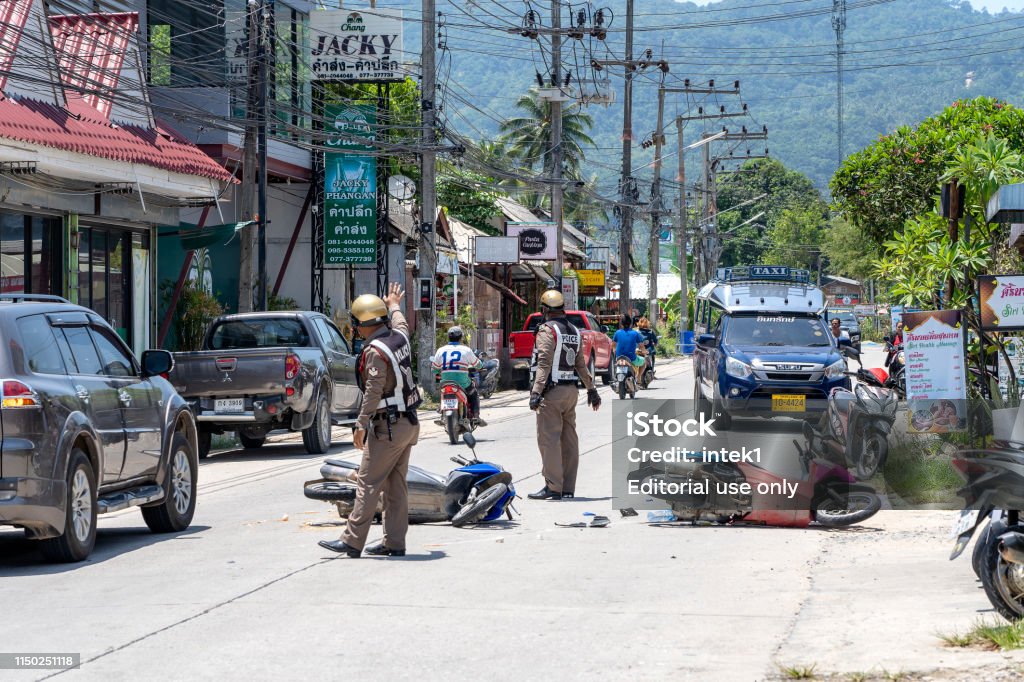
The Slow Lane Menace: When Careful Means Clueless
In Thailand, you get two types of driver, both on the road at the same time.
The slow driver apparently taking care but not concentrating. He can turn in front of you without any signalling or warning.
The driver or biker who gets frustrated by this and overtakes on a blind bend at speed. Not restricted to male riders.
So as well as being flexible at times, they can have a “me first” attitude—they’d rather hit you than give way.
At least once every half-hour of driving I see this. It’s become so routine that I barely flinch anymore. That’s the scary part.
Red-Yellow-Black: Decoding the Curb Colour Code
One of the first things you notice as a newcomer to Thailand’s roads is the paint. Kerbs are splashed with red, yellow, and black stripes. It looks decorative, but it’s actually a crucial piece of the driving puzzle—if you know what you’re looking at.
Here’s the breakdown:
- Red and white stripes mean no parking at any time. Absolutely forbidden.
- Yellow and black stripes mean no parking but you can stop briefly to drop off passengers or load goods.
- Red and yellow stripes mean no stopping at all—not even for a second.
In practice, however, these rules are treated as optional suggestions. You’ll see cars parked on red-and-white stripes outside 7-Elevens, trucks unloading on yellow-and-black, and motorbikes weaving through it all as if the paint doesn’t exist.
The locals know the rules. They just choose to ignore them when it’s convenient. And it’s almost always convenient.
The 0.05% BAC Limit: A Rule That’s Flexibly Enforced
Thailand’s legal blood alcohol limit is 0.05%—stricter than the 0.08% you’ll find in many Western countries. On paper, this should make the roads safer. In reality, enforcement is where things get interesting.
Police checkpoints are common, especially during holidays and festivals like Songkran. But the breathalysers used are famously unreliable. Many expats and locals joke that the “real” rule is just to avoid smelling like alcohol at all.
If you get pulled over and there’s even a hint of booze on your breath, the conversation often shifts from law enforcement to negotiation. How much is this going to cost me? That’s the unspoken question hanging in the air.
Some drivers avoid the checkpoints entirely by taking alternative routes. Others rely on the time-honoured tradition of smiling, apologising, and hoping the officer is in a good mood. It’s not exactly a system designed to deter drink-driving.
The Unwritten Rule: Might Makes Right
There’s a hierarchy on Thai roads that isn’t in any official Highway Code. It’s understood by everyone, and it governs how drivers behave in ways that the written rules never could.
The hierarchy goes like this:
- Trucks and buses sit at the top. They’re big, they’re slow to stop, and they will not yield to anything smaller.
- SUVs and expensive luxury cars come next. They can bully motorcycles but must defer to trucks.
- Motorcycles are near the bottom. They’re nimble and fast, but they usually avoid collisions.
- Pedestrians are at the very bottom. Crosswalks are suggestions, not rights.
This pecking order creates a fascinating dynamic. The driver of a pickup truck knows they can force a scooter to swerve. The scooter rider knows they can cut in front of a car. Everyone knows their place, and everyone acts accordingly.
Right of way isn’t given. It’s taken. If you hesitate, you lose your chance. This isn’t aggression—it’s pragmatism. And it’s why Thai driving feels so chaotic to Westerners who are used to following fixed rules.
The Soi Dog: More Predictable Than a Traffic Light
I’ve said it before and I’ll say it again: a soi dog is more predictable than a Thai traffic light.
Consider this. The traffic light has turned to red but the police officer is calling me forward. Cars from the left and the right are obviously taking advantage of the cop’s allowing everyone to ignore the red traffic light.
This is becoming a free for all. Just drive on slowly, I suppose. That’s what everyone else seems to be doing. We are only complying with a signal given to us by the strong arm of the law.
At least with a soi dog, you know what you’re getting. They sleep in the middle of the road, they wander aimlessly, and they occasionally chase motorbikes. But they’re consistent about it. Traffic lights? Not so much.
The Art of the Thai U-Turn
Thais have developed a creative solution to the problem of turning right or going straight on at a red light. Instead of waiting, they’ll regularly go left and do a u-turn then go either straight on or left, depending where they wanted to go.
It’s ingenious, really. Why wait at a red light when you can simply go around it?
The only catch is that they won’t do it if cameras are visible or if any police on duty are likely to take a note of their registration numbers. But if the coast is clear? All bets are off.
This manoeuvre is so common that it’s practically a national sport. Watch any busy intersection for ten minutes and you’ll see at least half a dozen drivers pull this trick. It’s efficient. It’s creative. And it’s utterly terrifying if you’re not expecting it.
The Police Helmet Check: A Game of Smiles
Goong told me this evening that she was in a hurry to get to work this morning and didn’t stop for a police helmet check. She just smiled and said she was late for work. He beckoned for her to go on her way.
Personally, I think he should have at least made her put her helmet on.
This is the paradox of Thai law enforcement. The police are capable of cracking down—during “purges” you’ll see them stopping every motorcyclist without a helmet. But outside of these campaigns, enforcement is sporadic at best.
The result is a system where the rules exist, but compliance is optional. You can drive without a helmet, without lights, with three or more people on a motorbike, and as long as you smile and don’t make a fuss, you’ll probably be waved through.
Mai pen rai. No problem.
The Driving Test That Isn’t Really a Test
There’s no on-road driving test in Thailand. You’re asked some questions, drive around a short circuit with the examiner supposedly watching you, carry out some reaction tests, and collect your licence.
That’s not a recipe for good driving standards or safer travel.
Compare this to the rigorous testing in countries like the UK, Germany, or Japan. In those places, you spend months learning, practice for hours on real roads, and face an examiner who will fail you for the smallest mistake.
In Thailand, the test is more of a formality. The real learning happens on the roads—by copying, by observing, and by surviving.
It explains a lot, doesn’t it?
Why the ‘Mai Pen Rai’ and ‘Me First’ Mindsets Coexist
One of the most confusing things about Thai driving is the apparent contradiction at its heart.
On one hand, Thais are famously relaxed. Mai pen rai is the national motto. Don’t worry. It doesn’t matter. Let it go.
On the other hand, Thai drivers can be incredibly aggressive. They’ll cut you off, overtake on blind bends, and refuse to yield even when it’s clearly their turn to give way.
How do these two mindsets coexist?
The answer is that they’re not contradictory at all. Flexibility is for when you’re the one being inconvenienced. “Me first” is for when you’re in a hurry.
The same driver who lets you merge into traffic with a smile will also cut across three lanes without signalling if they’re running late. It’s not hypocrisy—it’s situational pragmatism.
Are Thai Drivers the World’s Worst? Let’s Be Fair
It’s easy to label Thai drivers as the worst in the world. The statistics are damning—road accidents in Thailand are the second highest in the world per capita.
But let’s be fair.
There are some very skilled drivers in Thailand. Watch some artic drivers manoeuvring and reversing on small sois. Those working on VIP protection duties are trained to high standards to be able to cope with driving their passengers away from any emergency which occurs. And they do that fast and safely.
The problem isn’t skill. It’s training, or the lack of it. It’s enforcement, or the lack of it. It’s a system that allows people to learn by copying bad habits instead of by formal instruction.
The result is a country where the gap between the best and worst drivers is enormous. You can have a professional driver with military-level training sharing the road with a teenager who’s never had a single formal lesson.
That’s not a recipe for safety. That’s a recipe for chaos.
How Thai Children Learn to Drive
Kids are naturally curious and observant when riding on a parent’s bike. So, perched on the front near the handlebars, they pick up a lot of ideas on how to drive.
When they themselves have a motorbike or truck they already have a host of driving techniques to call upon!
This is how driving culture is passed down in Thailand. Not through formal education, but through observation and imitation.
A child sees their parent run a red light. They see their aunt park on a double yellow line. They see their uncle overtake on a blind corner. And they file all of this away as normal behaviour.
By the time they’re old enough to get a licence, they’ve already absorbed a complete set of driving habits—many of them dangerous, all of them deeply ingrained.
Change the system, and you change the next generation. But the system is hard to change, because everyone learned the same way.
Learning to Adapt: My Personal Philosophy
One feature of Thai driving that I do like, however, is the use of lights as a warning of presence and an indication that you are coming through. Flashing has no other meaning and significance as it may have in the West. I have only seen a few drivers, whom I suspect are farang, flash their lights to call you forward to proceed.
My own view is that you adapt your driving, but still keeping safe, to the style of motoring in your host country. Anyone who has driven in say, France, Greece, India etc. will appreciate that.
You can’t impose Western driving norms on Thai roads. It doesn’t work. The rules are different, the expectations are different, and the consequences of being “right” in a collision are the same regardless of who had the right of way.
So you learn. You watch. You adapt. And eventually, you start to understand.
The 80-Year-Old Uncle Who Parked in Hedges
Reminds me of an 80-year-old uncle—he was an undertaker in a village in Starcross, Devon—being asked by a driving examiner where road users should not park their vehicles. Presumably, the correct answer includes: not on a hump back bridge, not near a zebra crossing, not on a bend etc. etc.
His reply always made me laugh.
“Don’t know about any Highway Code Book. Never been a keen book reader. I only ride around the village on my moped. If I stop anywhere, I’d just park it in a hedge. I’ve no intention of riding in big cities like Exeter anyway.”
It’s funny because it’s relatable. Who among us hasn’t encountered a driver who seems to have learned the rules from something they’ve read on the back of a cereal box?
But in Thailand, that’s not the exception. That’s the baseline. And that’s why the roads are the way they are.
What I’ve Learned After All These Months
After all my observations and experiences, what have I actually learned?
I’ve learned that Thai driving is a reflection of Thai culture. Flexible, pragmatic, hierarchical, and deeply resistant to formal rules.
I’ve learned that you can’t change it by complaining. You have to adapt.
I’ve learned that smiling at someone who nearly killed you is not submission—it’s survival.
I’ve learned that the roads are chaotic not because Thais are bad drivers, but because they’ve created a system that works for them. It’s just a system that outsiders find terrifying.
Your Turn: What Do You Think?
I’ve shared my observations. Now I’d love to hear yours.
Have you driven in Thailand? What was your experience?
Do you have a theory about why bikers don’t look before pulling out of sois?
Have you adapted to driving in a foreign country? What was the hardest adjustment?
Drop a comment in the box below. I genuinely want to know what you think.
A short piece about me and my writing in Thailand
https://understanding-thailand.com/about-me-2/
A useful Wikipedia article on Thai roads and driving
https://en.wikivoyage.org/wiki/Driving_in_Thailand
A follow-up to this post
More Tales from Driving in Thailand That You Won’t Believe – Understanding Thailand
The content and final editing remain my own.