(Childhood Memories of J.O. Williams)
A Welsh Godfather.
My first contact with a Mafia boss happened when I was eight years old, in a Welsh primary school. I didn’t know he was a Mafia boss at the time – I knew nothing of mafias, or corruption, or the real ways of the world.
My best friend was Johnny Illsley. He was a year younger than me but had been moved up to my class.
Johnny’s family lived in a large house in the coastal village of Ogmore-by-Sea, in Wales. One afternoon we were playing in their gardens when we ran up to greet his granddad returning from his office in Pencoed, South Wales – from which he ran his many businesses.
Neither of us knew then that his granddad was the Mafia godfather John Oswald Williams. A rich and extraordinarily powerful businessman with international and government connections dating back to the 1930s.
Who Was J.O. Williams
J.O. was born on 28 March 1886 and died on 6 July 1963, aged 77. His wife, Ethel Kate Williams (née Cobb), died on 20 March 1956, aged 69.
Although the family was well respected locally, no one knew much about them. The “respect” was at a distance. There was an aura around them – particularly around J.O. You never spoke first. You instinctively knew your place. They were generous to the local community without ever getting overly involved.
You always felt a barrier between you and the family, as if they lived on a different plane from non-members. It wasn’t an unpleasant barrier – but it certainly existed.
The family were, and remain, understandably secretive about their past. That is true of many families, whether Mafia or not. That veil of mystery will never be fully lifted. Later generations tend to use their wealth – however it was originally obtained – for charitable donations within their community. And those donations are usually very generous.
How Did J.O. Become So Powerful?
The UK and Newfoundland governments are, even now, tight-lipped about certain events. Some documents have been released under Freedom of Information requests; some have not. You can check for yourselves.
Since the story is complex, we need to pay close attention to how the business started, how and why J.O.’s plans began to go wrong, and how – and why – he ultimately won the day.
In the early hours of 3 February 1940, J.O.’s son, Eric Arthur Williams, his daughter-in-law Olga d’Anitoff Williams, and their daughter Erica d’Anitoff Williams died in a house fire in Port Hope Simpson, Newfoundland.
The cause of their deaths was never fully established. The Royal Canadian Mounted Police Serious Crimes Unit opened its investigation as late as August 2002 – 39 years after J.O.’s own death.
No reports on the deaths have ever been found. No medical report from the doctor who apparently attended to Olga at the scene has ever been found. No death certificates have ever been found.
It was always suspected that the fire and deaths resulted from grievances J.O.’s employees had over his treatment of them. Correspondence confirming this suspicion exists in the UK National Archives.
J.O. Williams directed that the original tombstone bearing his daughter-in-law’s name be removed. He had a new stone shipped from South Wales many years later. After the deaths, he forbade any talk of Olga.
She was the granddaughter of a Russian count, and there are letters in the UK National Archives stating that J.O. considered her to be of poor character.
The fact that the UK government collected so much information on Williams shows how much they feared him.
Omertà and Government Complicity
Williams’ affairs in Newfoundland were hushed up. In the lead-up to the Second World War, a climate of trust in political leaders was vital for morale. The last thing the United Kingdom and Newfoundland – its steadfast ally – wanted was to be distracted from the war effort. They regarded what J.O. was doing as a relatively trifling business dispute.
The word used by the Mafia is Omertà – the Southern Italian code of honour and silence that places importance on non-cooperation with authorities, law enforcement, and outsiders. In this case, those same people were turning blind eyes. They also did not want to rock the boat and draw attention to their own governments’ complicity.
I suspect J.O. often reminded them how much they themselves were gaining from his activities. He would have reminded them of their own involvement in his business dealings. He was outsmarting them at every turn.
What set J.O. apart was that he countered criticisms by playing his opponents at their own game – and he played by his own rules when existing laws did not serve the family’s interests. There was never any direct retaliation. People did not “push” J.O. Williams.
He was very much his own man, rarely swayed by the wishes of others. He was respected – and, in that sense, feared. The aura around him stopped any suggestion of questioning his judgment.
We see how J.O. manipulated politicians in the UK and Newfoundland. He sought friends and influential contacts and avoided making enemies whenever he could. He wanted people on his side.
Politicians had difficulty dealing with or controlling him. They claimed the cover-ups were in the public interest. But was it not also in their interest to construct a cover-up?
It was only much later that I pieced together enough facts from my childhood contact with the family to realise that this was a traditional Mafia family. They were not considered gangsters or criminals. They simply operated and lived their lives in a different way from the rest of us.
The Cottage and Uncle John
If ever there was a misnomer for a house, it is “The Cottage”. It was the largest house in Ogmore-by-Sea. J.O. and “Uncle John” had the entire upper floor, while J.O.’s daughter, Doreen, and her husband, “Lofty” Illsley, lived on the ground floor.
Doreen’s full name was Katie Doreen Illsley (née Williams). Born in 1910, she died in 1996 aged 86. Johnny would have been about 47 when she died – probably the first time he had access to family correspondence and photos.
But what of the “other son” who worked with J.O. in his Welsh company operations and lived at The Cottage? Always referred to as “Uncle John” by Johnny and myself.
As he bore a striking resemblance to other members of the Williams family, I suspect “uncle” was not merely an honorary title. There is an unidentified photo from the limited archives available that could be of Uncle John at an early age. He bears a strong resemblance to Eric – the son who died in the fire – but I do not think it is him.
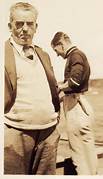
Eric would die in a house fire in Newfoundland in 1940, along with his wife and daughter. The governments involved are still silent. But the boy who played in those gardens didn’t know any of that yet. He only knew the man who didn’t queue for tickets, and the quiet double who lived upstairs.
If you search for The Cottage, Ogmore-by-Sea, you will see a rear view from the main road. The house was much larger than it appears. In the 1960s, there were uninterrupted views from the front, over extensive gardens and land, to the Bristol Channel.
The land between the house and the coast was owned by the Williams family but rented to a local farmer – though they retained right of access.
Lofty Illsley installed a small changing facility near the boundary wall for bathing in the sea. They would drive down in summer; it was too far to walk. Johnny and I spent many happy hours there, crossing the wall and reaching the sand within two minutes.
J.O. allowed only one house to be built on his land before most of it was sold off much later for an extensive housing development (Marine Walk, Marine Drive, etc.). That house belonged to “Boss” Williams, the local headmaster – no relation. It was set well back from J.O.’s residence.
Moments I Remember
The Rugby Game
Johnny and I were taken to a local rugby match by his granddad. While J.O. parked his Armstrong Siddeley, we dutifully queued for tickets.
He called us over and bypassed the queue. Johnny’s granddad simply said, “J.O. Williams. J.O. Williams,” as we all walked through the turnstiles unchallenged. After the match, we went into the directors’ box for lunch.
The Firework
At a bonfire night party, Uncle John ran through the crowd with a lighted firework in his hand, throwing it only seconds before it went off. Johnny and I were scared stiff.
The family often invited friends and locals to festivities like this. They did not make close friends outside their circle but were happy to put on events where villagers were warmly welcomed and made to feel at ease.
The Fish and Chips
Johnny’s parents took us for a weekend break in their campervan. Lofty Illsley went to the local fish and chip shop to buy chips to accompany the fish Doreen had prepared. The shop would not serve him chips on their own. So he paid for fish and chips – and threw the fish away.
What These Moments Reveal
The rugby incident showed J.O.’s supreme confidence and his realisation of his powerful godfather position. He commanded and received respect.
Uncle John with the firework – and the family’s broader hospitality – showed how a Mafia family creates a presence within a community without getting overly involved, while still appearing friendly and positive. They gained respect, and people knew the family would help them if they asked.
Lofty throwing the fish away showed, in a curious way, a steadfastness of purpose. Totally confident in himself. All are Mafia traits. This is how Mafias are run in the everyday world. They are businesses like any other.
As we see in Mario Puzo’s The Godfather, the methods used were sometimes justified – in their eyes – to keep the family’s reputation and respect intact against what they saw as an unfair society run by a wealthy establishment that only looked after their own interests.
Conclusion
In the context of the J.O. Williams family and my personal observations, I see a Mafia as a benevolent dictatorship run essentially as a family concern.
The violence has been overplayed. The only deaths in this true story were those three family members in the 1940 fire – and they were probably committed by loggers with grievances over working conditions. They took the law into their own hands. That in itself is a typical Mafia strategy.
J.O. wanted to create a wealthy and powerful family. There is no evidence that he ever used violence. As far as I am aware, he was not involved in drug smuggling, protection rackets, human trafficking, illegal gambling, or bootlegging.
It is not illegal to outwit international governments and make a great deal of money doing so.
Provided you showed him respect, J.O. would be benevolent towards you, and you would be regarded as a member of his extended family. Although he was open to discussion and would listen, his decisions were final.
He saw the crookedness and unfairness of much in society. He knew at first hand the corruption, bias, and self-serving nature of the political and judicial establishment.
We think of the Mafia as a corrupt organised crime family not following the law as we know it. In that sense, Mafias are examples of a dysfunctional and broken system. The Mafia businesses themselves, of course, see it differently: to them, it is the establishment – the government – that is corrupt and dysfunctional.
As portrayed in film, we are told that Mafia families are violent criminals with no redeeming features.
But that is not what I saw as a boy in Ogmore-by-Sea. I saw a powerful family that demanded respect and, in return, offered protection and generosity.
J.O. Williams outclassed governments without firing a shot. That may not fit the movie script. But it fits the man I glimpsed from a child’s distance.
© Matt Owens Rees 2026
The content and final editing remain my own.