How John Oswald Williams of Ogmore-by-Sea built a mafia empire stretching from South Wales to Newfoundland, and outmaneuvered two national governments. Johnny Illsley and I learned the truth about him only after his mother died, leaving him the family diaries and photos.
The Godfather of Ogmore-by Sea.
I was an 8-years old schoolboy. Johnny was a year younger than me, but sharp enough that they’d bumped him up into my class. We spent most of our free hours doing what boys in coastal Welsh villages did: running, climbing, getting into things we shouldn’t.
One afternoon we were playing in the gardens of his grandad’s large house when a car pulled up.
Out stepped Johnny’s granddad, returning from his offices in Pencoed. We ran over to greet him. He patted us on the head, said something warm and unremarkable, and went inside.
At that time, wearing muddy wellies, I had absolutely no idea that Johnny’s grandfather was the godfather of Ogmore-by-Sea.
Johnny’s family lived in a large house in Ogmore-by-Sea, a quiet village perched on the edge of the Bristol Channel, where the wind comes in off the water and the grass grows sideways. It was, and still is, the kind of place where everybody knows everybody else. Or thinks they do.
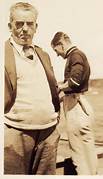
Johnny’s Grandfather — John Oswald Williams
J.O. — John Oswald Williams, born 28 March 1886 — was, by every visible measure, a respected local businessman. His wife, Ethel Kate Williams, née Cobb, was well regarded. The family were generous to the community. They put on firework parties every 5 November. J.O. supported Bridgend Rugby Club.
Williams and his son John always acknowledged village folk when driving their car. In a Welsh village, that counted for a great deal.
But there was always something else. Something harder to name. You didn’t speak first around J.O. It wasn’t a rule anyone stated — it was simply understood.
There was a barrier between the Williams family and everyone else, though it wasn’t hostile. It was more like the invisible line around someone who operates on a slightly different frequency from the rest of us. Pleasant enough. But unmistakably there.
Looking back, the word for what J.O. cultivated was presence. He had it in extraordinary abundance.
The family kept to themselves in the ways that mattered. They were not close friends with anyone outside their circle. They didn’t need to be. They had their own world — and that world happened to include connections stretching from South Wales to Newfoundland to the corridors of two national governments.
Lofty Illsley
The Williams family lived in a house called. The Cottage, Ogmore-by-Sea. As names for houses go, it’s one great understatement. It was the largest house in Ogmore-by-Sea. J.O. and the man Johnny and I knew as Uncle John occupied the entire upper floor. His daughter Doreen — Katie Doreen Illsley, née Williams — lived on the ground floor with her husband, “Lofty” Illsley, who was Johnny’s father.
Lofty was a character in his own right. I remember once being taken for a weekend in the family’s campervan. He went to buy chips to go with the fish Doreen had already prepared. The shop refused to sell chips alone — policy was fish and chips together, or nothing at all. So Lofty bought the fish and chips, walked outside, and threw the fish away.
At the time I found this mildly funny. Later I understood it differently. That’s not stubbornness. That’s a man who has decided, at some fundamental level, that the rules other people live by simply do not apply to him — not out of arrogance exactly, but out of an absolute confidence in his own judgement. It’s a small thing. But it’s a Mafia thing.
The Moment that’s Stayed with me the Most
The moment that has stayed with me most clearly — the one that, in hindsight, tells you everything — happened at a local rugby match.
Johnny and I had queued for tickets like good boys. J.O. had gone to park his Armstrong Siddeley. When he came back and found us in the line, he simply said: come with me. And we did. He walked straight to the front, turned to the man on the gate, and said, quietly: “J.O. Williams. J.O. Williams.” That was all. No argument. No confrontation. The man stepped aside and we walked through.
After the match, we had lunch in the directors’ box.
Two words — his own name — were all it took to part a crowd. That is not something you buy. That is something you build, carefully, over decades. It is the architecture of power maintained not through force but through the slow accumulation of respect, obligation, and reputation. The kind of power that doesn’t need to announce itself, because everyone already knows it’s there.
Then there was Uncle John.
He bore a striking resemblance to other members of the Williams family, which always made me wonder whether “uncle” was more than a courtesy title. He was involved in J.O.’s Welsh business operations, lived on the upper floor of The Cottage, and was, like everyone in that family, a man of few unnecessary words.
I remember him at a bonfire night party — another of the events the family put on for the village. He ran through the crowd with a lit firework in his hand, holding it until the very last second before hurling it away. Johnny and I were terrified.
But that was the point, in a way. Not cruelty — theatre. The Mafia family as host, as spectacle. Generous, warm, slightly dangerous, and always reminding you, without saying so directly, that they were operating by different rules.
The Fire of 3 February 1940
The deeper story — the one I only pieced together much later — begins in the early hours of 3 February 1940.
In Port Hope Simpson, a remote settlement in Newfoundland, Canada, a house caught fire. Inside were J.O.’s son Eric Arthur Williams, his daughter-in-law Olga d’Anitoff Williams — granddaughter of a Russian count — and their young daughter Erica.
All three died.
No cause was ever formally established. No medical report from the attending doctor has ever been found. No death certificates have surfaced. The Royal Canadian Mounted Police did not open a serious crimes investigation until August 2002 — thirty-nine years after J.O. himself had died.
Correspondence in the UK National Archives suggests the fire was connected to grievances held by J.O.’s employees — loggers who felt they had been treated badly, and who took the law into their own hands.
J.O.’s response was, in its own way, characteristic. He had the original tombstone bearing Olga’s name removed and replaced with one shipped from South Wales. He forbade any mention of her within the family. He erased her, quietly and completely, from the record.
What the UK and Newfoundland governments made of all this is something they were — and remain — reluctant to say. Some documents have been released under Freedom of Information requests. Others have not.
What we do know is that two national governments collected a great deal of material on J.O. Williams. Governments do not do that about men they consider insignificant.
Omertà
The word used in Southern Italy for this arrangement — the code of honour and silence, the deliberate non-cooperation with outside authority — is omertà. In J.O.’s case, it wasn’t just the family keeping quiet.
It was governments keeping quiet too, because they had their own reasons. The war was coming. Morale mattered. And men like J.O. had a habit of knowing exactly what the people around them stood to lose if the wrong questions were asked too loudly.
J.O. was, by all accounts, a patient and precise operator. He sought allies and avoided enemies wherever possible. He played the political game with skill, cultivating relationships with influential figures in both Wales and Newfoundland.
When those relationships required managing — when governments pushed back — J.O. had a way of reminding them of their own involvement in his affairs. Not a threat. Just a quiet acknowledgement of the way things stood.
Politicians, it turns out, are easier to manage than you might expect when they have something to lose.
How Most People Think of Mafia
I am aware that the word “Mafia” carries a weight of cinematic baggage — the horse’s head, the revenge killings, the operatic violence of Coppola’s films and Puzo’s pages. And I want to be clear: none of that is what I saw.
As far as anyone can establish, J.O. Williams never used violence. There are no credible links to drug smuggling, protection rackets, trafficking, bootlegging, or any of the traditional organised crime industries. The deaths in Newfoundland were almost certainly the work of aggrieved employees, not the family.
What J.O. ran was something simpler and, in some ways, more interesting: a family business that operated outside the normal rules — not through intimidation, but through the careful management of reputation, relationships, and silence. A benevolent dictatorship, run with discipline and a certain generosity, that demanded respect and offered protection in return.
That is, of course, still a form of power that most of us would find uncomfortable to live alongside. The fact that it doesn’t announce itself is not a mitigating factor — it may actually make it more effective, and in some ways more insidious, than the Hollywood version.
The violence in Mafia films is a distraction. Real organised power doesn’t need to be violent. It just needs everyone to know, without ever being told directly, exactly where the lines are.
The Cottage, Ogmore-by-Sea
J.O. Williams died on 6 July 1963, aged 77. His wife Ethel had predeceased him by seven years. His daughter Doreen lived on until 1996. The Cottage still stands in Ogmore-by-Sea.
The land between the house and the Bristol Channel — once rented to a local farmer, with the family retaining right of access — was eventually sold and developed into Marine Walk, Marine Drive, and the streets that now spread across what was once open ground.
Johnny and I used to cross the wall at the bottom of the garden and reach the sand in under two minutes. I suspect neither of us fully understood, even then, what we were standing in the middle of.
I have thought about those afternoons a great deal over the years. The garden. The car pulling up. The man whose name alone was enough to open any door he chose.
J.O. Williams outmanoeuvred two national governments without, as far as we know, ever firing a shot. He built a family empire that commanded genuine respect across a generation, covered his tracks with the help of people who had every reason to look the other way, and died at seventy-seven in a village on the South Wales coast.
That is not the Mafia of the movies. But it might be the more accurate version. The one that doesn’t make the front pages. The one that a boy might brush up against in a garden, and not understand for decades.
© Matt Owens Rees. May 2026.
The content and final editing remain my own.