
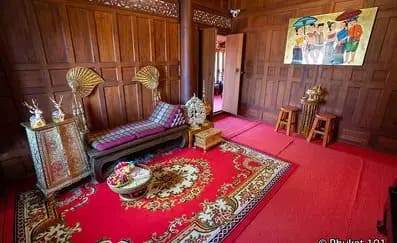
The hospital can do no more for Dta Sompet. He has been sent home to die. Friends and neigbours come to see him every day. Nearing death, he was moved to the Shrine Room and laid on a mattress. A monk offered prayers. When he died his body was placed on a castle-like structure in his garden. After a few days, it was taken to the crematorium to be burned in the open air.
The End of a Life.
He arrogantly insisted on some petrol money to go to the hospital.
My next door neighbour, Dta Sompet had been bitten by a neighbour’s dog. He needed an anti-rabies injection as a safeguard. Whether the dog was provoked or not was difficult to tell. Anyway, the owner paid for the hospital fees and the petrol.
However, he thought his demand for having his petrol costs paid was a little over the top. The families smiled when they saw one another but it was not the smile of close friends. It was the automatic Thai smile.
As farangs, we may not notice the coldness of the snub. The Thai smile is never easy to understand. Years went by with only a few words being exchanged. However, as we shall see, events changed.
I saw Dta Sompet most days. He was either reading his newspaper or doing some light gardening. He would always stop for a chat when neighbours walked by. I usually joined in the chitchat and banter. Thais love to gossip and joke.
Lately he had been unwell and had been taken to the hospital for check-ups. Although I still chatted with him, he was not his usual self. He was not as talkative or lively as before.
Whenever I asked his family if he was getting better, I was told he was okay. A standard reply from a Thai. They did not want people to feel sorry for them. This attitude of caring for the feelings of others, greng jai, is the Thais’ routine response to not putting you to any trouble. But I was genuinely concerned for his health.
I buttonholed his granddaughter, Renu, as she was riding her motorbike to university. She told me he was dying and that the surgeons could not operate on his kidney problem because of his age.
He was eighty-three years old and was being sent home to die.
I found him a kind-hearted man. His youngest daughter, Fai, was divorced and lived alone above her shop a few hundred metres away. It had been burgled twice. Until he became very ill, he had slept over every single night of the year without fail to protect her. Caring for other members of the family is a strong Thai trait.
We saw him that evening. He was lying on one of the long wooden teak benches that the Thais like to have in their homes. They are expensive because they are well crafted and ornate. Westerners find them uncomfortable even when provided with lots of cushions.
Dta Sompet was propped up on the bench to stop him falling to one side. He was cheerful enough. He smiled as we entered and understood what we were saying, very light-hearted stuff. We had often shared a joke together. But now he was quiet.
Dta Sompet often rested on a bench seat chatting to family and friends. But today he was silent. He knew he was dying
Only his wife, Khun Fon, and eldest daughter, Khun Faa, were with him when we visited. Many close friends had popped around during the day for a short while. Perhaps bringing a soft drink or something they thought he might be able to eat.
There were smiles and chattering amongst the visitors, but no assumption that he was going to survive.
The family was still concerned that they were causing an inconvenience to his visitors. Always, the family thanked them for coming round to see him. Always, the response from his friends was the same: “Mai bpen rai krap.” (Literally, it doesn’t matter).
It seemed an inappropriate response to their thanks but it is the correct one in Thailand. It wasn’t that they didn’t mind. They cared a lot. The meaning was that they did not need to be thanked for visiting their old and beloved friend. Mai pen rai can have many different shades of meaning. In the context of a man dying, it still seemed odd to a western ear.
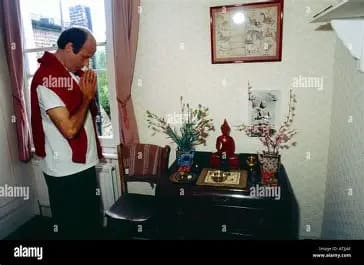
The next day he was moved upstairs and laid on a mattress on the floor of what one might call the “shrine room.” This room is typical of many Thai homes. In one corner stands a Thai altar with some Buddha images, flowers, candles, and photos of revered monks. This room is typical of many Thai homes. In one corner stands a Thai altar with some Buddha images, flowers, candles, and photos of revered monks.
Sompet was cheerful enough. He smiled as we entered and understood what we were saying, very light-hearted stuff. We had often shared a joke together.
After waiing at the Shrine, you return to sit on the floor with other friends and relatives. Dta Sompet is laying on a mattress
But now he was not able to talk. Only his wife, Khun Fon, and eldest daughter, Khun Faa, were with him when we visited, but many close friends had popped around during the day for a short while. Perhaps bringing a soft drink or something they thought he might be able to eat.
There were smiles and chattering amongst the visitors, but no assumption that he was going to survive.
The family was still concerned that they were causing an inconvenience to his visitors. Always, the family thanked them for coming round to see him. Always, the response from his friends was the same: “Mai pen rai krap.” (Literally, it doesn’t matter).
It seemed an inappropriate response to their thanks but it is the correct one in Thailand. It wasn’t that they didn’t mind. They cared a lot. The meaning was that they did not need to be thanked for visiting their old and beloved friend. Mai pen rai can have many shades of meaning. In the context of a man dying, it still seemed odd to a western ear.
I found him a kind-hearted man. His youngest daughter, Fai, was divorced and lived alone above her shop a few hundred metres away. It had been burgled twice. Until he became very ill, he had slept over every single night of the year without fail to protect her. Caring for other members of the family is a strong Thai trait.
How to Approach a Buddha Image
In presenting sticks of incense to a Buddha image, you cup three sticks in your hand and wai. On one side of the altar, there is a small plate of food and a glass of water that are replaced each day. This is a symbolic gesture much like decorating Christian altars with flowers.
Many family photographs are hung on the walls, together with pictures of past kings. On another wall are stacked many magazines and books gathered over the years. Most of the books are cartoons, or school or university entrance texts.
Apart from two small teak chairs, the room is otherwise not furnished. It is a place for quiet contemplation, not one for ordinary everyday use. Victorian front parlours in England were similar. Used only for resting a coffin or for very formal occasions.
Dta Sompet had not been laid in his own bedroom. For a Westerner it was a strange sensation to realise that his being laid on a mattress in the shrine room was signaling to everyone in the village that our friend and neighbour was dying. He would end his days in this room.
In the West, we talk of a deathbed. In hushed tones. There is little conversation and the atmosphere is sad. We may try to convince ourselves that there is a slim chance of recovery.
Thais are under no such illusion. To them, death is the final part of the normal life cycle. It may come unexpectedly but is regarded as a perfectly natural event.
There is sorrow and mourning but it is neither morbid nor solemn.
Dta Sompet was able to drink liquids and Khun Faa was spoon-feeding him some weak rice soup. The wife of one of his nephews was massaging his limbs and wiping off the sweat that was building up on his body. Someone else helped hold him so that he could be given some medication.
Thais can be very caring and comforting. They’ll do all they can to ease suffering.
The Monk’s Role When Death Approaches
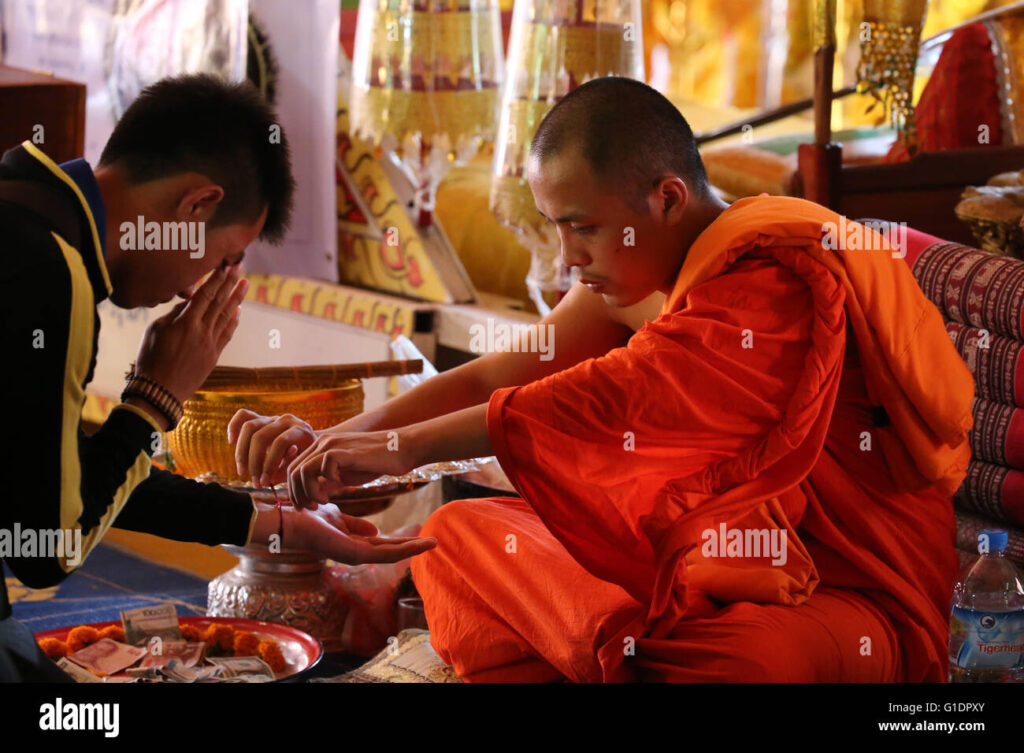
A monk arrived later in the evening and held a short prayer session. Khun Faa’s husband lifted Sompet’s thin frame so that a white ribbon could be wound round his wrist as a symbol of blessing and protection, the sai sin.
Dta Sompet was conscious and seemed quite reassured and contented at the monk’s presence. He was still too frail to speak but seemed to know what was going on and was quite at ease.
Over the next fourteen days, there was a constant stream of visitors to the home and the monks came a few times. It was very much open house where you just quietly walked in and went up the stairs to where he lay. The door was always open.
If Dta Sompet was sleeping people would just chat, the usual small talk. Everyone would help in any way they could. Just tidying up or handing out glasses of water or light refreshment.
The western way would be respectful but more formal; letting the family cope on their own most of the time. But this is Thailand and Dta Sompet’s friends would never let him be alone at this time. They came every day. Overnight there would always be one or two family members sleeping on the floor near him, not in their own bedrooms.
Then one morning, around ten o’clock, there was a continuous stream of friends and neighbours arriving by either foot or motor cycle. Leaving after just a few minutes. A sign that he had died.
Dta Sompet is Dead
I heard the pooyaibaan, (village headman) announce our neighbour’s death on the village loudspeaker system. It was half past ten. Dta Sompet had been dead for less than one hour. Yet around twenty people had already visited his house.
In small villages in Thailand, word travels fast. Communities are closely knit. In some provinces, the family starts wailing as a way of announcing the death. That did not happen here. Customs differ depending on province and region.
The mattress on which he had been sleeping during his last few days had been removed. The doctor and undertaker were yet to arrive. Dta Sompet was now lying, covered completely in a white cloth, on the bare floor of the shrine room.
I still find it strange that, although I was sitting right next to his covered body, I thought it quite natural to be doing so. In the West, we’d kneel in front of an open coffin but not lay next to the body immediately after death.
How We Paid Our Respects to Dta Sompet
Before walking up the stairs to the shrine room, each mourner places an envelope, with his name on, in a contribution box. That helps towards the funeral costs. You then wai to a photo of Dta Sompet, cup an incense stick in your hand, wai again, and place it in a silver bowl full of sand. This is a way of transferring merit to the deceased for the after-life.
How much money this was costing was a topical conversation piece. Listen to Thais speaking and you will notice how often numbers and prices crop up in everyday speech.
Condolences were offered to his wife, Khun Fon, and the family, but not in the same formal way as in the West. By just being there and showing that they cared, few words were needed. Just a slight smile of compassion. No crying. No tears.
Dta Sompet and Khun Fon had lived in this village for most of their lives. Both their families were well known and well liked. They were part of the community. They belonged.
The family concept is strong in this country. It is very important to a Thai to keep in close contact with the family. To always be there for one another. Families often live in the same compound or at least very close by. Thais like to live in close communities.
How a Thai Community Responded When Dta Sompet Died
This bereavement showed me the strength of family and neighbourliness in Thailand. The community that joined in during the happier days was there in equal numbers during this period of sadness.
I’ll be writing about the positive advantages of AI but also its serious dangers in an upcoming post.
Ruam took; ruam sook, sharing the good and the bad times together.
The wife of the neighbour whose dog had bitten Dta Sompet sent round her factory workers with chainsaws to help fell some lamyai (longan) trees near the house. Any bitterness that had accompanied the dog-biting incident was now clearly in the past. The two families would, however, never be exceptionally close.
Half a dozen men made short work of clearing an area that I later realised would be used for the erection of six large awnings. The space would be needed to cater for the large number of people coming over the next week to pay their respects.
That evening, and for the next two nights, a monk arrived to start the funeral rites, holding the traditional fan, the talapatr, in front of his face while chanting from the sutras, the Holy Scriptures.
These mantras are a means of passing merit to the deceased. Prayers are about the impermanence of life. Although the presence of only one monk is acceptable, particularly immediately after death, the usual tradition is that funeral rites are observed with an even number of monks.
This rule of even numbers is not always followed. Later in the week, there were usually six or eight monks in attendance.
You’ll notice that in Thailand traditions, customs, and indeed regulations, are not automatically adhered to. Funerals can take place with an uneven number of monks and parts of ceremonies are omitted.
You are unlikely to get a satisfactory answer if you ask for an explanation. The truth is that Thais value freedom above all else. They will adapt and alter to suit what they want to do.
Death is Part of the Thai Life Cycle
Death is regarded as the most significant part of the Thai life cycle and monks spend a significant part of their time at these ceremonies. Partly because he had died on a busy Buddhist holiday, and partly because he was so well known in the four hamlets that form this village, different monks arrived each evening.
There is no single funeral ceremony as in the West. The gnap sop, funeral rite, starts with the monks arriving on the day of death and continues until the cremation. Monks also attend when the cremated bones are interred or scattered on the waters of a river, and again when the 100 day memorial service, the tambon roi wan, is held.
Many people came to Dta Sompet’s home in this first week. The front door was always open during daylight hours. The format for visitors was broadly the same. On entering the home for the first time, you light an incense stick, put it in your hand in a wai like gesture, and place it in front of the photo of the deceased in the entrance hall.
Moving upstairs to the room where the coffin is resting, you first pay respect to the Buddha shrine. Three wais. Then, to the coffin, one wai. Unlike the normal wai of greeting from a standing position, these wais are completed by making a full wai from a kneeling position, then putting both hands on the floor, and lowering your head right onto your hands.
You then sit on the floor facing the monks, with your feet pointing away from them. The very infirm sit on chairs at the back. There were usually around thirty family, friends, and neighbours present.
All Thai homes have a san phra bhumi (spirit house) in the garden in honour of ancestors. This is a small half-metre square structure on a pedestal, which looks rather like a miniature sala or garden pergola. Usually with the long over-hanging roof so typical of Thai temples.
The Shrine in the Garden
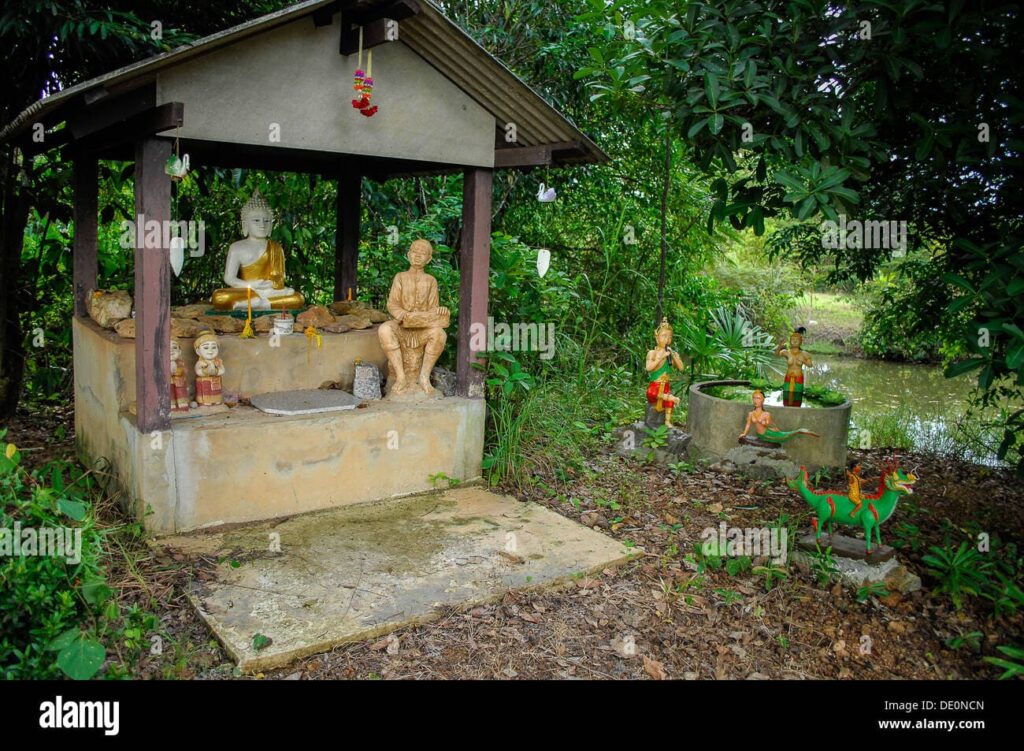
After Dta Sompet’s death, the custom of the family offering three incense sticks to the Buddha image inside the san phra bhumi continued. This was out of respect for those who had previously lived in the house. It was not specifically related to the present death.
As we have seen, Thais dislike shows of anger and people speaking loudly. In front of or near a spirit house, it would, they believe, cause offense to the spirits, bring bad luck, and not be following proper etiquette. So, people are quiet and respectful when they are near spirit houses. No one will offend the family spirit and harmony will be maintained.
This animistic belief is robustly followed in Thailand. Some Buddha icons are reputed to have magical powers of healing and creating wealth. Buyers of lottery tickets can be seen consulting such images at some of the famous shrines in Bangkok.
Generally, though, they are meant to be representative and reminders of the Buddha’s teaching, which is the reason you wai them.
During the day, after paying their respects in the shrine room, friends and neighbours would move into the garden to chat and eat.
In the evening, when the monks were present, most would stay in the shrine room for the rites. Some stayed outside but remained respectfully quiet. No loud talking or laughter.
The men always sit in front of the ladies during the religious service. But one evening a rather hi-so lady (or so she thought) sat next to her husband, with men sitting behind her. She was a little over-dressed too, with more than an acceptable amount of jewellery for a bereavement.
No-one commented, that would not be the Thai way, but the breach of protocol and manners was certainly noted. With a smile, of course. Thais try not to let you know what they are thinking. She and her husband, Damrong, only came to the house on that one occasion.
When the Monks Visit Every Evening
Each evening, some refreshment is given to the monks. Always by a man and always with a wai. The rite starts with chanting by a village elder before the monk begins his part of the ritual. The man who is chosen for this position is always well versed in how the wat (temple) conducts its services.
Most Thai men will have spent some time in the monkhood and he would have been one of the temple’s more devoted followers. Most men will stay a few weeks or a month at least. In the past, they were encouraged to stay for the whole of the four month rainy season, the “rains retreat.”
Some nowadays find an excuse to leave after a few days claiming pressure of work.
Monks do not wai lay people but novices often forget the newly learned rules. They frequently wai their parents and elders in their earlier days in the monkhood and refer to themselves as pom when it is mandatory for monks to use the word atama.
During most of the rite conducted by the monks, your hands are held in a permanent wai, though it is acceptable, if tired, to make a formal wai to the monks and then cup your hands in your lap.
Towards the end of the service, several bottles of water and glasses are handed to some of those present. Half the water is poured into the glass while the monks are chanting and the rest when they finish. The first half that is poured is a token gesture and is done to pray that the deceased has good karma.
You are performing this duty of pouring water for his benefit after death. The second half is to pray for your own karma.
Karma is the Buddhist belief that whatever you do comes back to you. If you do good, something good will happen to you in the future, either in this life or the next. The reverse is also true.
Before they leave each evening, the monks are presented with baskets containing food, drink, and maybe a flower and some toiletries for their personal use. The baskets are carried by the mourners down to a car taking the monks back to the wat. The gifts gain merit for the family and the deceased.
As monks do not have money to buy food and other essentials this is effectively a form of alms giving.
Chatting is not Disrespectful at Thai Funerals.
Chatting, either upstairs where the coffin lies or in the garden, will continue after the monks have left; conversations can be about anything under the sun and not just about Dta Sompet’s life. The atmosphere is much more informal and jovial than in the West, but there is no less respect.
Thais believe it is better for the family not to be left alone.
The western view is that a stream of friends popping in unannounced every day is not giving the family private time to grieve alone and come to terms with its loss. Being with this family and sharing its grief showed clearly how different the Thai and western cultures are.
It is for you to judge the merits, advantages, and disadvantages of the two styles of bereavement. We may think their customs strange; they don’t always understand ours.
The casket is bedecked with flowers and twinkling coloured lights are draped around it. A tray with a small plate of food and a glass of water is placed next to the coffin and refreshed each day.
The idea of placing food next to the coffin was once questioned by a Westerner during a funeral in Bangkok.
Westerner: Why place food near the coffin? He can’t eat it.
Thai: Why do you place flowers on a grave? He can’t smell them.
A good example of cultural differences, and an unobservant farang being put in his place.
Thais are Good at Hiding Their Emotions
Only once did I see any tears shed in public. Dta Sompet’s eldest granddaughter, Ning, arrived from Bangkok during the monks’ chanting and broke down while hugging her mum and grand-mum. She worked in the city as an IT consultant but spoke to her parents and the family several times a week, coming “home” every other month.
Thais habitually work a long distance from the family home as well-paying jobs are scarce outside Bangkok.
Ning composed herself quickly. Thais believe it frightens the deceased to see his family cry. They always try to hide their emotions.
Community in Thailand
As wreaths from groups and organisations arrive, they are placed behind the monks’ chairs and remain there during the evening services.
If members of the family are employed by companies or the government then it is usual for that organisation to send some representatives with a wreath. The fact that the deceased was not a member of that organisation himself is not relevant.
Another rather moving scene was when a group of some dozen young university students arrived on motor cycles dressed in sober colours to pay respects to the family and kneel in front of the coffin. These teenagers, from Renu’s university, came to offer her comfort and support.
The sense of community is so strong in Thailand that it was perfectly normal for these students to get together and contribute to the purchase of a wreath with money they could barely afford. Renu was a fresher student and had been in college for only two weeks.
I am not sure that would happen in the West.
No lotus flower was placed in Dta Sompet’s hand and no coin placed in his mouth. Traditions vary throughout Thailand and they are often modified to some extent, nothing is inflexible. There are no fixed rules of funeral etiquette. Sompet’s was a typically middle class Northern Thai funeral.
Particularly if the family’s house is too small or has no garden, the coffin may be kept at the local wat. The rituals are very similar. The family would not usually stay overnight. If they did, several members of the close family would keep vigil. Sometimes monks join them for part of the evening.
Light refreshments for the mourners are provided each day until the cremation. This can be two days, three days, or a week later. It depends on the family’s position and wealth. A royal funeral can last a year or more. The higher up the social ladder you are; the longer the number of days between death and the final rite at the funeral pyre.
In poorer families, the corpse is placed in an inner plywood coffin within the ornamental casket and cremation takes place within three days of death. At the crematorium, the casket is dismantled and taken away. The plywood coffin containing the body is then rolled into the fire chamber.
Particularly in rural areas, the tradition is for the coffin to be placed on a funeral pyre in the open air. For families that can afford it, formalin is used to slow down decomposition and allow a more extended period of mourning.
If the intention is for the body to be donated for medical science, it is kept in a refrigerated unit behind a screen. It is only put in the casket at the end of the religious ceremonies and before being placed in the hospital ambulance.
During the rites, the empty coffin is still revered and adorned with flowers and wreaths, although the actual corpse is preserved behind the screen.
Everyone Helps at a Thai Funeral
For Dta Sompet, members of the community did not just offer their condolences. They helped wherever they could. 400 chairs were brought in and arranged under 6 marquees and awnings. Funerals are regarded as social events where the entire community can take part.
During the first seven days, food is provided three times a day for those present. Not everyone came to every meal but cooking and distributing up to 1000 meals over a period of a week takes some organising. Music plays outside but that is turned off when the monks arrive.
There was only one person who seemed to come only for the meals. I never saw him helping and, although he was not ostracised or made to feel unwelcome, he never seemed part of the group. The Thais rarely, if ever, directly cold-shoulder you.
Nobody really leads or is in charge; everyone assumes the role to which he or she is best suited. When someone noticed it was getting rather hot in the tents, a couple of men got in a truck and brought back some fans from the wat to hang from the roof. No one told them to do so.
They just did it. When the driveway was looking rather the worse for wear from the volume of traffic, a load of shingle arrived and was spread over the area. A neighbour cleared a weedy area on the verge outside the house. She was not asked. She just did it. Thais involve themselves in their communities, but as individuals.
If you look closely, you’ll be aware that they don’t like working as a team. They smile, they respect one another, but there’s more to team-working than that. You may notice little structure in how something is organised.
Individualism is a Thai characteristic that appears enigmatic when compared with their willingness to engage in local events – whether funerals, fetes, or other social gatherings.
At Dta Sompet’s funeral, no formal paid caterers were employed. The community saw it as its responsibility and duty.
Men were chopping up meat; women were preparing and cooking. The men were making baskets of bamboo; the ladies were decorating them. It was very much a community event even though there was no overall direction. It appears coordinated because the traditions are well known and precisely followed.
The baskets were used as containers for the offerings to the monks and for general decoration around the coffin. Each day motor cycle sidecars arrived with bags of ice and bottled water. Ingredients for meals arrived on all sorts of transport from pedal bicycle to sidecar to pick-up truck.
Lottery sellers came round during the day. Electioneering pamphlets were handed out. The candidates were among the mourners.
In the West, community strength evolves from working together in a structured and possibly planned way. In Thailand, it works – and works well – by being more spontaneous with individuals aware of what needs to be done. You don’t hear orders being given in group activity.
The Coffin is Moved into the Garden
On the day before the cremation, and after the monks had completed the chanting of the funeral service for that day, the coffin was brought from the house into the garden. As the coffin was moved out of the room, all the men stood. It was the only time that this was done in the presence of the deceased. The monks stood nearest the coffin and offered prayers.
The men remained standing, partly to screen from the ladies present the movement of the coffin as it was being manhandled down the stairway to the garden. Everyone followed and the rite continued in the garden. The coffin was placed on a catafalque, to form an elaborate, tall, and ornate pyramid-like structure.
In some parts of Thailand, the tradition is for the coffin to be taken out of the house by a route not normally used. A wall may be broken down to make an exit or a rear door may be used.
An older custom is for banana leaves to be placed on the floor so that the deceased is not being carried over the normal bare floor. This did not happen here and these practices are becoming rarer.
Although booked with the authorities, no one wanted to confirm the actual time of the cremation. To a Westerner, this can appear as Thai evasiveness. To the Thai, not being precise is due to not wanting to be forceful.
“It starts at 1pm” could imply that you are expected to go whether you want to or not. Thais are just not that assertive. They speak indirectly and don’t like taking responsibility for giving out information which may prove inaccurate.
When you go to a wedding in Thailand, you mingle with guests for a few hours. A house-warming, tambonbaan, will last a morning and perhaps there will be a small party in the evening. Funerals are not scheduled for just the one day as they are in he West. The funeral rites start at death and continue until cremation.
It is no surprise, therefore, that you will meet more friends and neighbours during this time than on any other occasion. You may pop in one day and get chatting with a few friends, the next day you will meet some new neighbours over lunch. People are coming and going all the time.
You get to know a lot of people who live in the local community and they get to know you. The Thais will feel happy and at ease that you are fitting in to their culture and society as well as paying your respects to the deceased and his family.
When the rites are over, close family kept vigil at the coffin during the rest of the evening. A small group of friends and neighbours stay in the garden overnight chatting, watching a Thai soap on a screen erected in the garden, or playing cards. (Technically illegal in Thailand as the police will assume you are playing for money).
The deceased is never left alone. Inside and outside lights are not switched off at night.
The next day, from early morning, more and more people arrive until the garden is full to capacity. One neighbour built a makeshift bridge over a drainage ditch between his property and Dta Sompet’s in order to connect the two gardens and allow more space for the large number of villagers attending.
The man whose dog had bitten Dta Sompet opened his factory yard to provide more car parking space. He had not been asked to do so. This greng jai idea of not seeking favours from other people stops Thais from making such requests.
Neighbours use their initiative to know what they are required to do. Thais can at times be dogmatic and stubborn, but they are not an assertive people. They won’t explicitly ask for favours. They are, however, very skilled in dropping hints to get their own way.
Every seat is taken. Lunch is provided for everyone by the ever-efficient helpers, all members of the local neighbourhood. As an exercise in logistics, it is carried out flawlessly. Following the traditions of centuries, it is perhaps not surprising that everything runs so smoothly.
The Procession to the Cremation Site
Before the procession starts, the monks conduct a service upstairs in the shrine room but it is now also relayed to villagers gathered outside in the garden. No one minds Sompet’s beloved dogs barking during the monks’ chanting and indeed some friendly chatting is not taken as being disrespectful.
The morning service, in the shrine room, took the usual form except that each mourner put some blessed rice into the monks’ alms bowls, which were linked by a white cord to a photo of the deceased. That cord was also connected, through an open window, to the truck that Dta Sompet used to drive. In the back of the truck, also attached to the cord, was the bicycle that he rode.
Some Articles You May Like To Read
https://en.wikipedia.org/wiki/Thai_funeral
Although written in a different style to my colleague, I try to follow the standards of good anthropological practice established by the late Carol Hollinger.
https://understanding-thailand.com/about-me-2/
As you can see, my published posts are quite varied. Something for everyone. Not always Thai related.
My Published Posts – Understanding Thailand
The content and final editing remain my own.
