The different types of wai and the rules when waiing the royal family, monks, superiors, serving staff, and children
How to wai in Thailand.
The general rule is you wai (the formal Thai greeting of respect) to a person older or superior to yourself. That person then returns the wai. Like all rules, there are exceptions. Returning a wai is not automatic.
The wai is more than a greeting. It carries the entire Thai social structure within it — respect for age, for rank, for the sacred. A handshake tells you little about the relationship between two people. (Except masonic handshakes—but that’s off-topic).
A wai tells you everything. Who initiates it, how high the hands are held, whether it is returned and how — all of this communicates status, respect, and context in a single gesture.
Thailand is a deeply hierarchical society. That hierarchy is not resented or hidden. It is openly expressed and generally accepted. The wai is one of the clearest expressions of it. Foreigners who understand this are not just learning a greeting. They are gaining an insight into the way Thai society thinks and organises itself.
It is also worth saying that the wai is not merely formal. It can be warm, spontaneous, and genuinely affectionate. A child running to wai a beloved grandparent is not performing a ritual. The gesture carries real feeling. That combination of structure and warmth is very Thai — at least in daily personal interactions, which is where most visitors experience the country.
You would wai the King and other members of the royal family. The King would not wai back. He wais only to a Buddha image or a monk. The monk represents the Buddha and does not return the wai.
A superior will not usually return the wai from a subordinate. But context matters. If a manager met a staff member outside the office, and she was with her parents, he would return her wai. Status is not the only factor.
Not waiing at a Restaurant
On my first visit to Thailand, we were eating in a restaurant. Opposite us was a large party — around a dozen people, with an important-looking man at the head of the table. He was almost certainly the boss. His guests were most likely his staff.
The restaurant was busy and informal — plastic chairs, fluorescent lighting, food ordered by pointing at dishes on neighbouring tables. Large Chang beer bottles sweating in the heat. The kind of place where Thais eat well and cheaply, and where nobody stands on ceremony. It was not a setting that demanded formality. But it was a setting that still demanded basic human decency.
The waitress was young, probably no more than twenty. She moved quickly between tables, managing a room full of demanding diners with the kind of quiet efficiency that good waiting staff everywhere develop early. She was doing her job well, waiing customers. She deserved at minimum to be treated like a person.
I have eaten in hundreds of Thai restaurants over the years, from street stalls to hotel dining rooms. The vast majority of Thais, regardless of status, treat serving staff with basic courtesy. A nod, a smile, a quiet thank you. It costs nothing and it matters. What I watched that evening was not a cultural difference I needed to respect. It was one man behaving badly. There is a difference, and it is important to recognise it.
He didn’t return the waitress’s wai. That was expected — you don’t wai serving staff. What I thought was plain rude came next. He called her from the other end of the restaurant just to top up his beer. The bottle was sitting right next to his glass. This was no high-class restaurant with wine waiters on hand to anticipate your every need. He didn’t nod. He didn’t thank her.
She showed no sign of embarrassment. Many Thais are skilled at masking their feelings in public. Inside, she may well have been seething. As Westerners, we must accept the customs of other countries. But accepting customs doesn’t mean copying bad manners. I would have filled my glass myself if it was running low.
If she had come over anyway, and topped me up, I would have smiled smile and thanked her. Basic politeness costs nothing.
How to Wai — The Mechanics
How you place your hands matters as much as when you wai. Get it wrong and the gesture loses its meaning. Get it right and Thais will genuinely appreciate the effort.
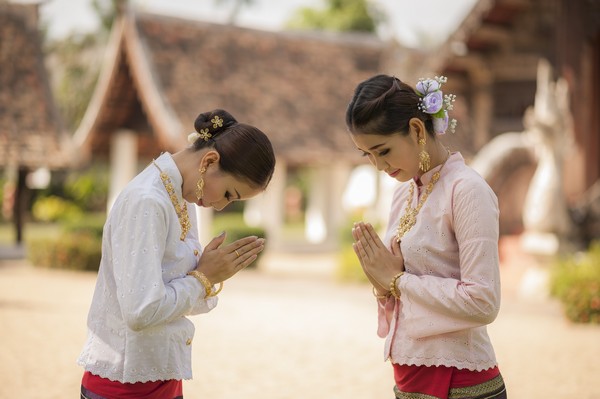
Place your palms together, fingers pointing upward. Think of a prayer position. Your hands should be held close to your body, not thrust outward. The higher you raise your hands, the greater the respect you are showing.
There are three broad levels. For most everyday situations — greeting a friend, thanking someone, acknowledging a stranger — your fingertips sit at around chest height. For people deserving greater respect, such as teachers, elders, or senior colleagues, raise your hands so fingertips reach your nose. For monks and members of the royal family, fingertips should reach your forehead.
At the same time, lower your head slightly toward your hands. The deeper the bow, the deeper the respect. Eye contact is not expected during a wai. Looking downward is respectful, not rude.
For women, feet should be together. Men typically place one foot slightly forward. These are subtle points but Thais notice them.
You do not need to hold the position for long. A brief, sincere wai is better than a prolonged, awkward one. If someone wais you unexpectedly, a smile and a gentle nod is always acceptable if you are unsure how to respond. Thais are forgiving of foreigners who make the effort, even imperfectly.
One final point. Do not wai while holding something in your hands if you can avoid it. Put down your bag, your drink, or your phone first. It shows the gesture has your full attention.
Waiing Children — When and Why You Don’t
This often surprises visitors. In most social situations, adults do not wai children. The wai flows upward — from younger to older, from lower status to higher. A child wais an adult. The adult may smile, nod, or pat the child on the head in return. A full wai back is not expected.
This is not about being dismissive of children. It is simply how the hierarchy of the wai works. The gesture carries weight precisely because it is not given equally in all directions.
There is however an important exception. In a formal or ceremonial setting, such as a school performance or a graduation, an adult might offer a gentle wai to acknowledge a child’s achievement. This is a mark of pride and recognition, not a departure from the rules.
Parents do not generally wai their own children in everyday life. But a grandparent might offer a small wai to a grandchild on a special occasion, such as a birthday or a religious event. It is a moment of tenderness rather than protocol.
As a foreigner, the safest approach is simple. Smile warmly at children. If a child wais you, smile and nod in return. You will not cause offence by not waiing back. You may however cause great delight by doing so — Thai children often find it charming when foreigners attempt the gesture.
What you should avoid is waiing very young children in a formal way. It can seem odd and slightly comical to Thai onlookers. A smile is always the right response to a child.
Princess Sirindhorn’s Popularity Among Thais
I once saw Princess Sirindhorn give a general wai to a group of people as she walked toward them — not directed at any one individual, but at the group as a whole. As she spoke with them, they all knelt and held their hands in the highest wai position, fingertips almost touching their mouths.
It was a small moment but a telling one. It said much about her warmth and her connection with ordinary Thai people. Most members of the royal family would not wai a general crowd. That she did revealed something about her character that Thais deeply respect.
Here’s an article covering her life, charitable work, and her place in the hearts of the Thai people.
Princess Sirindhorn — Wikipedia
The Wai in Business Settings
Thailand’s business culture is built on hierarchy and face. The wai sits at the heart of both. Understanding how it works in a professional setting will serve you well, whether you are visiting for a week or working in the country long-term.
When entering a meeting, wai the most senior person in the room first. If you are unsure who that is, look for subtle clues — seating position, body language, who others defer to. Getting this right signals awareness and respect.
In a formal business introduction, exchange wais before exchanging business cards. The card itself should be handed over with both hands and received with both hands. Take a moment to look at it. Tucking it away immediately without looking is considered dismissive.
You do not need to wai every time you pass a colleague in the corridor. A nod and a smile is fine for repeated daily encounters. Reserve the wai for greetings at the start of the day, introductions, and departures at the end of a meeting.
Foreign women working in Thailand often ask whether the rules differ for them. In most business settings, the same principles apply. Wai those senior to you. Do not be surprised if a Thai man does not initiate a wai to a foreign woman — he may be uncertain of the protocol. Take the lead yourself and it will always be well received.
One thing to avoid is the over-enthusiastic wai. Some foreigners, charmed by the custom, begin waiing everyone constantly. This can feel performative to Thais rather than respectful. Sincerity matters more than frequency.
The golden rule in business, as elsewhere, is when in doubt, wai. You will rarely go wrong by showing too much respect. You can easily go wrong by showing too little.
Common Mistakes Foreigners Make
Thais are patient and genuinely warm toward foreigners who make an effort with local customs. But there are a handful of mistakes that come up again and again. Knowing them in advance will save you some awkward moments.
Waiing everyone regardless of context. As mentioned above, over-waiing can look performative. You do not wai a street food vendor, a taxi driver, or a shop assistant. A smile is the right greeting in these situations. Save the wai for where it carries meaning.
Returning a child’s wai with a full formal wai. It tends to amuse rather than impress. A warm smile and a nod is the natural response.
Waiing with one hand. The wai is always two hands together. A one-handed gesture reads as casual at best and dismissive at worst. If you are carrying something, put it down first.
Getting the hand height wrong. Raising your hands to forehead level when greeting a colleague signals the reverence reserved for monks. Match the level of the wai to the person and the situation.
Women should never touch a monk or hand objects directly to them. However, a woman can wai a monk. Place any offering on a cloth or surface within his reach rather than handing it directly.
Waiing while walking briskly past someone. The wai deserves a moment’s pause. A wai thrown over your shoulder while hurrying looks insincere. Slow down, make the gesture, then continue.
Forgetting to wai at all. This is the most common mistake of all. Offering your hand to a Thai who is preparing to wai creates an awkward collision of customs. When in Thailand, lead with the wai.
Thais extend enormous goodwill to foreigners attempting their customs. An imperfect wai offered sincerely will always be better received than no wai at all.
About Me and My Work as a Writer
About Matt Owens Rees — Understanding Thailand
The content and final editing remain my own.