Why is Driving in Thailand so dangerous?
Some observational snippets of driving in Thailand, and comparisons with other countries. Written in a crisp style. Motorists, Motorcyclists, and the Maze of Thai Roads: Infrastructure Gaps, Police Practices, and the Everyday Reality of Driving Culture.
On 15 May, a Thai motorcyclist rode into my car causing 68,000 baht of damage. Fortunately, my insurance assessor spent several hours questioning bystanders, watching CCTV footage, and taking photographic evidence. It shows the rider as being in the wrong. The Police, however, will take 3 to 4 weeks to produce their report and I can’t authorise repairs until then. I’ll keep you updated.
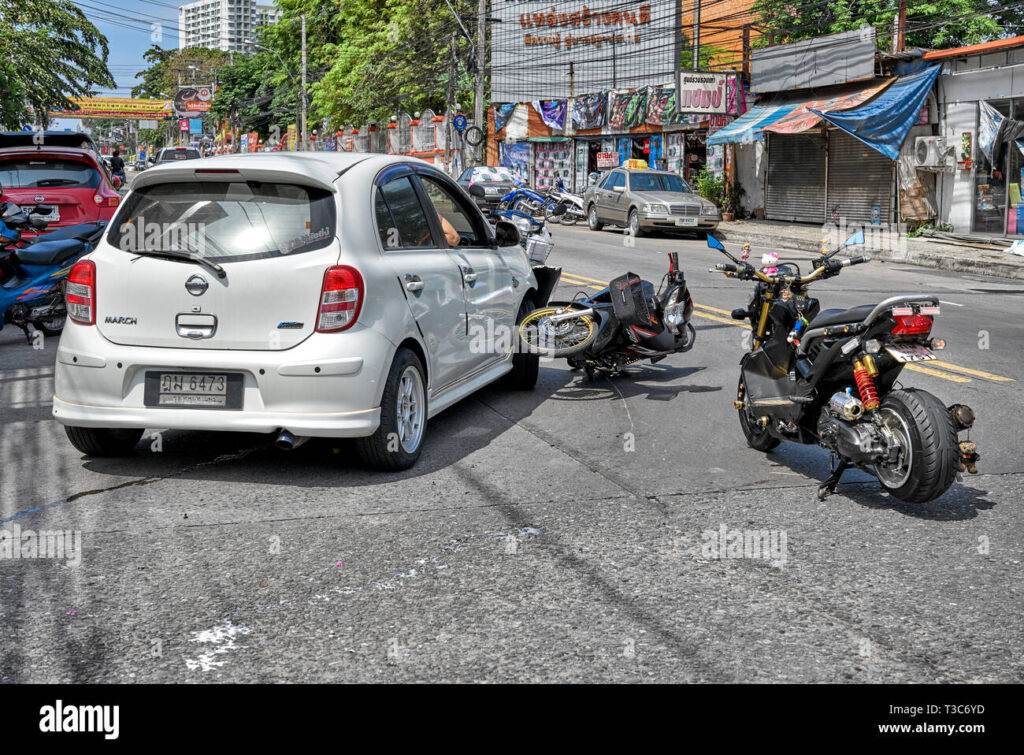
A Thai motorcyclist rode into my car causing 68,000 baht of damage. My insurance assessor has given the police CCTV, photographic, and witness evidence showing the biker to be at fault. The police will take to produce their report and I can’t authorise repairs until then.
Now, back to this true story.
I just don’t get it. Why do motor cyclists pull out from sois (alleys) onto a main road without looking? This is one of the two things I still don’t understand about Thailand.
Very few roads have cycle lanes where riders are separated from the main traffic. All too often, those lanes will have cars parked in them or a stallholder will have set up his goods for sale. Riding round a bend, you may find your lane abruptly ends.
If a car is coming towards you, you may not have time to swerve to avoid.
The Buddhist view is that life is full of suffering and is impermanent. That your life is predetermined so that you have no control over events anyway. I’m not convinced that is the reason. But, it may explain why Thais don’t take road safety seriously.
The police will rarely prosecute a motor cyclist for any dangerous riding offence. Perhaps motor cyclists realise that. In a collision with a car, the motorist will usually be blamed and pay for the damage to the bike.
Particularly up-country, many riders are uninsured and may have no licence in any case.
It is common for riders to approach on the wrong side of the road. In most cases, you can clearly see them and adjust your driving accordingly. Weaving in and out of lanes is expected.
Bikers regularly move directly from the cycle track to the offside lane in order to complete a U-turn. Overtaking on your left even when you’re signalling left is common practice.
Whichever country you drive in, you will soon get accustomed to their particular way of driving. Drive defensively and assume others will make mistakes.
Who Goes First in Thailand?
Large trucks will always assume precedence, as if they have right of way even when they do not. Drivers of expensive looking cars will often push their way through. That’s the power of hierarchy for you. All Thais know their station in life and some take full advantage of that.
In the West one car may turn at a junction in the face of oncoming traffic if it is safe to do so. Following cars usually stop. In Thailand, when one car goes all the rest will follow. I now do the same. It is understood that the cars will wait for all the vehicles to turn.
In England, when a driver flashes their headlights it can mean either they’re coming through or they’re giving way. In Thailand, flashing one’s lights has only one meaning. You’re coming through. I’ve only once seen a driver flash to let me through and his intention was clear as his vehicle was stationary.
At a four-way junction some Thais will put on their hazard lights to show they are going straight on. Quite a good idea.
Thailand’s hot weather probably makes dogs lethargic and not want to move out of the way of approaching vehicles. They may be clever enough to realise drivers will do all they can not to hit them.
Motor cyclists have a similar view that cars will make way for them.
Thais park where they want. It’s not that they are inconsiderate of other road users. It is because they feel they have freedom to do their own thing. If the noodle shop is on a bend then that is where they will park. Other Thais don’t mind. They would do the same. The police will drive past with the same mai pen rai attitude.
My 80 year-old Undertaker
Reminds me of an 80 year old uncle – he was an undertaker in a village in Devon – being asked by a driving examiner where road users should not park their vehicles. Presumably, the correct answer includes: not on a hump back bridge, not near a zebra crossing, not on a bend etc. etc.
His reply always made me laugh.
“Don’t know about any Highway Code Book. Never been a keen book reader. I only ride around the village on my moped. If I stop anywhere, I’d just park it in a hedge. I’ve no intention of riding in big cities like Exeter anyway.”
Sometimes, a car will stop to allow you to join the main carriageway from a side road. Sometimes, you may need to edge out slowly, hoping they’ll stop.
Most Thais don’t wear safety helmets. If caught by police, they pay the fine, put the helmet on, and ride around the corner. Stop and put it back in the front basket. I’ve seen them doing sharp U-turns to avoid police check-points.
When Geng was killed in a motorcycle accident – he was not wearing a helmet – thirty riders attended the pre-crematorium meal. Only two were wearing safety helmets. I seemed to be the only one who was surprised.
A lot of reactions on the internet forums today. An Aussie motor cyclist is in hospital and his girlfriend is dead following their road accident.
The incident was captured on CCTV. It shows the Aussie tourist first turning left and then to the right before trying to ride into his hotel. A Thai motorcyclist who was following tried to overtake and hit both rider and pillion as they were making the turn. One witness said the Thai rider was following too closely and was speeding.
From the CCTV it appears there was fault on both sides. The Aussie, who may not have been used to the bike he had rented, was badly positioned for the turn. He had probably seen the hotel entrance only at the last moment.
It is claimed the police were offered a bribe and the whole blame was transferred to the Aussie tourist. He refused to sign a police report written in Thai agreeing he was at fault.
Balanced opinion goes by the board and flaming is the order of the day. However, this case is a little different. The CCTV evidence is clear and the foreign media reaction is unwelcome. There will be a damage limitation exercise put in place. A police officer has already been transferred, and an investigation promised.
The end result though will be that nothing will be done. Tomorrow it will be yesterday’s news.
The Police Don’t Always Help
I was stationary in traffic when a motorcyclist tried to squeeze between my car and an old pick-up truck. He did not succeed. He scraped the paintwork along one side of my car, broke the wing mirror, and dented the rear end of the truck.
Where are the police when you want them?
I was in luck. An officer on point duty saw what happened and told me and the biker to go to the police station. Luckier still, or so I thought at the time, the police station was only 50 yards away down a nearby soi.
The motorcyclist gave the truck driver 200 baht and he seemed happy with that. His truck was pretty ancient and battered anyway. He thought making a claim would be a waste of time. He drove off once he had the cash.
At the police station the motor-cyclist admitted blame. He could do little else. All the necessary documents were photocopied, reports were completed in triplicate, and we all went on our way.
A month later, I went to the station to ask about progress.
“We’ll send someone round to his house”.
Another month went by. “He’s waiting to be paid at the end of the week then he’ll pay you”.
Later. “He’s left the country and is in Myanmar”.
I should have got some money out of him as the truck driver did and not involve the police. It was a case of “can’t pay, won’t pay”. Whether he had bribed the police, I know not.
Put Your Seat-belt on
Even if it was not a legal requirement in Thailand, I would always fasten my seat belt before driving. Clunk, click, every trip was the motto in England.
But I had stopped to ask directions, and was told my destination was just round the corner. No point putting on the belt for a 3 minute drive.
I drove round the corner and saw the police check-point. I quickly pulled on my seatbelt.
One of the officers signaled for me to pull in. I lowered the window and, as is usual in Thailand, he saluted smartly. He politely asked to see my licence, asked what country I came from, and started talking about Arsenal football club.
All very pleasant and friendly. This was obviously just a routine licence check. I was in luck. He was obviously a decent copper.
“I’m going to have to give you a ticket. I saw you put your seatbelt on after you came round the corner.”
He still had my licence. The procedure would have been for me to go to the police station and pay the fine. I would need to have found the station first and then wait for ages while the paper work was completed.
I decided on the Thai approach. “Pom jai ngern hai khun dio nee. Taorai na kap. (Can I pay you now? How much?)”
My wallet was 400 baht lighter but I was not given a ticket. I had my licence back. He halted the traffic to allow me to pull out, and gave me an even smarter salute than before.
Collecting minor fines in this way is common practice. The money is shared out later at the station. It’s regarded as a perk of the job and really forms part of officers’ salaries. It rewards individual officers while cracking down on motoring offences. A win-win solution.
Drive Within the Distance You Can Stop
Driving too closely to the vehicle in front is a major cause of accidents in many countries. It takes away your margin of safety if the vehicle in front of you suddenly stops. If he stops, can you stop? Always ensure you can stop within the distance you can see to be clear.
Two motor-cyclists collided and one is seriously injured. It is not clear whether they were riding in parallel or one was overtaking the other. Perhaps they were racing. When rounding a bend, a following car crashed into one of the bikes. It somersaulted into the air and landed on the other rider.
The driver of the car drove off. A Thai radio channel reported that the police checked ownership of the vehicle to a senior government official. He claimed his son was driving at the time. The son denies that he was responsible.
What the hell. The traffic light has turned to red but the police officer is calling me forward. Cars from the left and the right are obviously obeying the green light that they have now been given.
This is becoming a free for all. Just drive on slowly, I suppose. That’s what everyone else seems to be doing. We are only complying with a signal given to us by the strong arm of the law.
Thailand’s police are always busy with crash helmet or seat belt purges. Riders driving carelessly or dangerously are ignored. Three or more people on a bike, driving without lights, parking on a blind corner. Mai mee panha. No problem. Freedom of the individual to defy the occasional contravention of regulations is the order of the day. No need to make a fuss.
Goong said she was in a hurry to get to work this morning and didn’t stop for a police helmet check. She just smiled and said she was late for work. He beckoned for her to go on her way. Personally, I think he should have at least made her put her helmet on.
Follow the Leader
I wanted to turn right at a busy junction. The car ahead of me made the turn when he saw a gap in the traffic coming towards him. I followed, copying the Thai way of “following my leader.” Thai drivers accept that when one goes, the rest will follow.
I noticed four or five cars behind me did the same.
You don’t see that in the West. To be safe, one needs to adapt to the driving style of a country’s drivers and not drive as one would at home.
There’s no on-road driving test in Thailand. Thais are asked a few questions, and drive around a short circuit with the examiner supposedly watching you. Machines test your reaction times, whether you can distinguish red from green. You’re asked to watch a road safety film.
When I last renewed my licence, nobody was watching the film. The whole room was engrossed on their mobiles. The supervisor knew but didn’t care.
One feature of Thai driving that I do like, however, is the use of lights as a warning of your presence. It’s an indication that you are coming through. Flashing has no other meaning and significance. It doesn’t mean, “I’m letting you through”.
I have only seen a few drivers, whom I suspect are farang, flash their lights to call you forward to proceed.
It’s common in rural areas to use hazard lights to indicate you are going straight across at a road junction.
Not the Usual Traffic Jam
Got caught in a traffic jam today. It looked like there was an accident up ahead. Cars and trucks were moving at a snail’s pace.
Getting nearer, we realised the congestion was caused by cars and motor bikes parked on both sides of the road. Close to a newly set up market stall.
A stall-holder had taken the initiative to set up his stall at a busy intersection. Too much of a bargain for people to pass by.
Police may or may not come later and move him on.
I was waiting patiently at a junction for a motor bike to pass. I didn’t want to pull out in front of him. The rider turned left into the soi without signalling. Great. He smiled the usual Thai smile.
I would have been annoyed if that had happened in the West. I’m used to it now. Sometimes I even smile back. It’s what the Thais would do.
Such inconsideration for other road users would not give them a second thought.
The driver and ticket sellers on Bangkok buses are on commission. The more fares they collect; the higher their earnings. Moving off quickly after picking up a passenger is the rule. The driver may not even pull in to pick up a sole person waiting at a stop. He knows he can pick up many more passengers at the next one. He has every incentive to get there before a rival bus does.
It can be annoying when he decides to take a short cut, missing out some bus stops. It does not happen often but it does occur. Just get off at the most convenient stop near your original destination or catch different bus going in that direction. Passengers don’t object. They take it in their stride, mai pen rai. It’s no big deal.
Karma or Bad Luck?
Cycling over the bridge, I pulled up by a small group of people peering over the edge. They were watching men pulling on a rope to get a small truck that had slipped down the river bank. Only the front wheels were on firm ground. Eventually, they tied the rope to a lorry, whose driver had stopped to help. It was still a long process to drag the truck right up.
The Thais who were watching said it was karma. A strongly held belief in Buddhist countries. That was the reason for his misfortune. They said the driver was a well-known local villain. I thought the problem was he had driven too close to the edge of the river’s bank.
They were adamant. It was the driver’s bad karma.
Drivers of cars, and sometimes coaches, will take their hands off the wheel and wai when passing a Buddhist shrine. The shrine would have been erected as respect to those who had died at the accident black spot.
You’ll see small kids sitting in front of mum or dad holding the motor-cycle handlebars. That is a Thai child’s first experience of motoring. They learn how to ride and drive on Thai roads from that first experience. They copy how their parents ride. They see how the rules of the road are ignored and remember that for the rest of their lives.
On the other hand, there are some very skilled drivers.
Watch the drivers of articulated vehicles maneuvering and reversing on small sois, or those working on VIP protection duties. They are trained to very high standards in order to get their client away from any possible danger or emergency.
My own view is that you adapt your driving to the style of motoring in your host country. Anyone who has driven in say, France, Greece, India etc. will appreciate that.
All nationalities drive differently. I remember driving from the airport in Athens and being stopped at a traffic light. The cars ahead of me were tooting their horns. It didn’t make the lights change any more quickly. But it was common practice. Not sure if that still happens.
Driving in Paris is an experience like no other. The French drive fast and seem to assume drivers will mainly keep to the rules. Everyone will have their own recollections of driving in other countries.
To turn right or go forward at a red light Thais regularly go left and do a U-turn. They can then legally go on their way. They won’t do it if cameras are visible or if any police are on duty.
The larger or more expensive the vehicle, the more the driver will flaunt the rules of the road. Never assume a large truck, coach, or “hi-so” car is going to keep to driving regulations. They’ll do what they want to do.
Motor cyclists will overtake on either side of you even if you’re signaling to turn. A no-entry sign is not always observed; expect two way traffic on one-way streets.
Care must be taken when motorcyclists swerve out at the last minute to avoid a big hole in the road. Rightly or wrongly, the rider would not be blamed. The motorist would pick up the tab for any damage or injury. In this country the person assumed to have more money than the poor motorcyclist pays.
Asking a Thai why motor-cyclists (and sometimes cars) come out of sois without looking, I never get an answer.
Even some seasoned farang expats resort to the old chestnut, “It’s not just Thais, it happens all over the world.”
That’s true. But these expats intentionally miss the fact that it happens more in Thailand than in the West. Why some farangs regard themselves as unpaid apologists for Thailand is something else that is difficult to understand.
Conclusion
Are bikers adopting a mai pen rai attitude? Do they really believe it doesn’t matter that they’re putting their lives and those of others in danger.?
Is it related to the doctrine of predestination, whatever will be will be? That one has no control over one’s destiny.
Is it because they know police officers called to the scene of an accident will find the other party at fault? Most officers will have first learned driving skills on a motor bike themselves. They are sympathetic towards the biking community.
If they’re not insured, and most are not, it’s more pragmatic to get the motorist or his insurer to pay.
As in some western countries, the emphasis is on collecting fines for minor traffic offences in order to improve revenue targets. It’s not about strong policing and the implementation of regulations.
So — why do you think driving in Thailand is so dangerous? Comment in the Comment Box and share your views with other readers.
Profile of Matt Owens Rees
https://understanding-thailand.com/about-matt-owens-rees/
An Overview of Thai Road Safety
Click for an up-to-date report on driver behaviour and problems with road infrastructure.
https://asiantransportobservatory.org/analytical-outputs/roadsafetyprofiles/thailand-road-safety-profile-2025/
© Matt Owens Rees. May 2026.
The content and final editing remain my own.