How twenty friends travelled through the night to sing the university anthem, respect the Buddhist rites, cry at their grief, and then – because it’s part of their culture – laugh, sing, and make merry at the wake: the Thai way of releasing grief after the body was burned.
A Thai cremation: The story of Seri
Understanding the Background
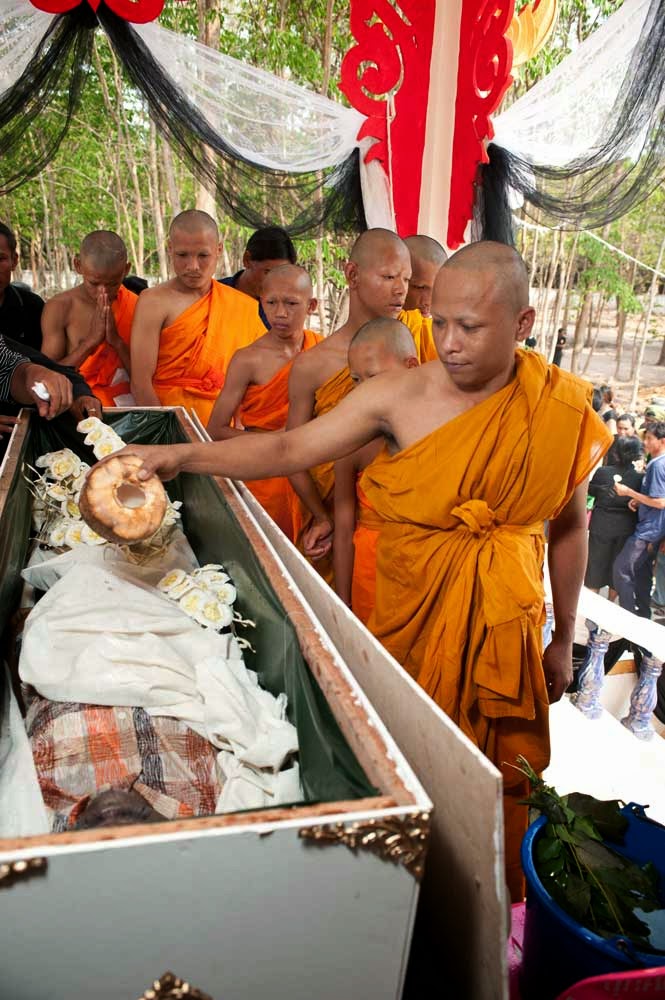
Seri died at the young age of 42. Her health had declined because of the stress of looking after her aged mother. Twenty of Seri’s year group—women with whom she had graduated many years before—travelled miles to be at her funeral.
Taking an overnight train or flying up-country from Bangkok, necessitating a few days off work, did not seem out of the ordinary either to them or to their employers.
A collection had been made for the family and handed over by the eldest in the group. They helped in other ways too. They copied a photo of Seri in her university robes from a Facebook page and framed it so that it could be carried at the head of the funeral procession.
Buddhist monks officiate when someone dies, holding prayers with the family either at the home or at the temple, wat. They then lead the procession to the crematorium.
After prayers around the coffin, they return to their seats overlooking the site so that the mourners can say their final farewells.
Seri’s family were poor and could not afford the chemicals that would have prevented flies from moving around the body. The flies didn’t affect the final goodbye, but I felt uneasy.
The Final Goodbye
We all formed a circle around the coffin, draped with the university flag, and sang the college anthem.
Westerners often see the Thai as rather stoical, not showing emotion easily.
But singing this farewell to their former classmate brought a few tears to many eyes.
It is normal, of course, to console people so that they regain their composure. And that happened here.
After the cremation, walking to the wake, one girl started to cry. A few of her friends said some comforting words to her. I instinctively put my hand on her shoulder, as I would have done in the West.
Life Goes On
When we reached the room where the wake was being held, the atmosphere changed completely.
Just five minutes after the “burn”, as most Thais call it, everyone in the group was laughing and joking. This is the Thai way of responding to grief—a big cultural difference. In the West, there may be smiles and light chatter, but not laughter and gaiety.
A Cultural Note
Watching this, I understood something I had only sensed before. Thais seldom use the word colleague or acquaintance, though those words exist in the language.
They prefer friend. “She’s my friend” can just mean someone from the same company, spoken to only a few times.
The use of “friend” makes bonding easier. There is a strong sense of comradeship within all Thai families and communities.
Keeping in touch with old school chums, former work and university colleagues comes naturally to the Thai. When they marry, children will often build their home right next to their parents house.
So unlike in the West where children “fly the nest” and lead their own lives. Meeting with family at weddings and funerals. Certainly, not telephoning every day as a Thai would.
And here’s an in-depth article on Thai funerals.
https://en.wikipedia.org/wiki/Thai_funeral
Readers may like to know a little about what motivates me and how it influences my writing.
What Motivates Me as a Writer
Readers may wonder what drives my work and how my background shapes my writing.
I’ve lived in Thailand for over 20 years as both a long-term expatriate and a cultural anthropologist.
Over that time, I’ve learned that truly understanding this country — and integrating more deeply with its people and culture — requires less talking and a lot more observing and listening. After all, we have two eyes, two ears, but only one mouth.
My focus group didn’t develop overnight, but it now pays real dividends. I can test ideas on Thais from nearly every social stratum: poor farmers and construction workers, office and shop staff, bankers, wealthy business owners, and even members of the so-called hi-so elite.
Because Thais are often cautious about expressing views openly in front of fellow citizens, some interactions must be one-to-one.
Just last month, a construction worker and a banker gave me completely opposing views on the recent constitutional referendum. Rather than picking a side, I learn from both.
That’s the core of my approach — whether through field research, everyday conversation, or lecture hall discussions, I try to present a rich picture of the real Thailand, warts and all.
I’ve written extensively on Thais and Thailand, with 20 published books now available in eBook and print.
Though my style differs, my work reflects some of the same observations found in Carol Hollinger’s Mai Pen Rai Means Never Mind — still, in my opinion, the best introductory book on Thais and Thailand. Its insights remain remarkably fresh and revealing, even decades later.
Sadly, Hollinger passed away at 45 before seeing her best-selling book in print. With her death, I lost the chance to collaborate with her on a new book about the concept of “face” in Thailand. That lost opportunity continues to motivate me today.
© Matt Owens Rees May 2026
The content and final editing remain my own.