If you thought “My Top Tips” covered everything, think again. Thai roads are a never-ending source of true stories: a monk stopping traffic, fishing in a pothole, smiling at near-death collisions, unpunished hit and runs, and an 80-year-old uncle who ignores road regulations and the law.
More tales from Driving in Thailand that you won’t believe.
The Day a Monk’s Ordination Stopped the Traffic
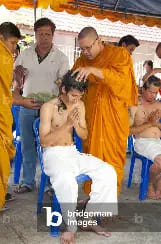
A few months ago I was stopped in traffic when a long procession of several initiates completely took over the narrow soi leading to a temple. The family beckoned me to join them. As there was no chance of my moving the car, I parked and walked over.
Dancing, singing, smiling, joking. Then a whisky bottle was passed around. The only person seemingly not enjoying himself was the novice monk himself. Unfair I thought, as the pending ordination was the sole real purpose of all this merrymaking. Dressed all in white and with his hands in the wai position, his solemn face had no hint of a smile.
That’s Thailand for you. One moment you’re stuck in traffic, the next you’re at a party. But the roads don’t always offer such warm welcomes.
A Straightforward Independent Article on Monk Ordination
https://traveltothailandblog.com/what-is-it-like-to-be-ordained-as-a-monk-in-thailand/
When “Following the Leader” Becomes a Way of Life
I wanted to turn right at a busy junction and the car ahead of me made the turn when he saw a gap in the traffic coming towards him. I followed, copying the Thai way of “following my leader.” Thai drivers accept that when one goes, the rest will follow. I noticed the four or five cars behind me did the same.
You don’t see that in the West. To be safe, one needs to adapt to the driving style of a country’s drivers and not drive as one would at home. It’s a lesson I’ve learned the hard way.
The Hit-and-Run Nobody Will Be Punished For
Driving too close to the vehicle in front is a major cause of accidents in many countries. It takes away your margin of safety if the vehicle in front of you makes a mistake and you are unable to stop within the distance you can see to be clear and avoid a rear-ender.
Today, two motor-cyclists collided and one is seriously injured. It is not clear whether they were riding in parallel or one was overtaking the other. Perhaps they were racing. The situation worsened when, rounding a bend, a following car crashed into one of the bikes and somehow made it somersault into the air. It then landed on the other rider.
The driver of the car drove off. It is reported on a Thai radio channel that the police checked ownership of the vehicle to a senior government official but he claimed his son was driving at the time. The son denies that he was responsible.
And there, in a nutshell, is the problem. Someone will pay—but will it be the right someone?
The Law That Isn’t Really Enforced
What the hell. The traffic light has turned to red but the police officer is calling me forward. Cars from the left and the right are obviously obeying the green light that they have now been given.
This is becoming a free for all. Just drive on slowly, I suppose. That’s what everyone else seems to be doing. We are only complying with a signal given to us by the strong arm of the law.
Apart from when they are on crash helmet or seat belt purges, the country’s finest don’t routinely go after motorists or riders driving carelessly or dangerously. Three or more people on a bike, driving without lights, parking on a blind corner. Mai mee panha. No problem. Freedom of the individual to defy the occasional contravention of regulations. No need to make a fuss.
Goong told me this evening that she was in a hurry to get to work this morning and didn’t stop for a police helmet check. She just smiled and said she was late for work. He beckoned for her to go on her way. Personally, I think he should have at least made her put her helmet on.
Learning to Drive Without Ever Leaving the Sofa
There’s no on-road driving test in Thailand. You’re asked some questions, drive around a short circuit with the examiner supposedly watching you, carry out some reaction tests, and collect your licence. That’s not a recipe for good driving standards.
Driving tests are done off-road in Thailand and last only a few minutes. They watch a safety video but are not subjected to a particularly rigorous Highway Code test with a high pass mark.
Reminds me of an 80-year-old uncle—he was an undertaker in a village in Devon—being asked by a driving examiner where road users should not park their vehicles. Presumably, the correct answer includes: not on a hump back bridge, not near a zebra crossing, not on a bend etc. etc.
His reply always made me laugh.
“Don’t know about any Highway Code Book. Never been a keen book reader. I only ride around the village on my moped. If I stop anywhere, I’d just park it in a hedge. I’ve no intention of riding in big cities like Exeter anyway.”
Funny, yes. But in Thailand, that’s not an exception—it’s the rule.

Parking: The Art of Leaving Your Vehicle Anywhere
Amazing how Thais park their cars and bikes wherever they like. A few motorbikes had some near misses this morning on a corner where two cars had double-parked. Thais aren’t the most careful of road users.
Got caught in a traffic jam today. It looked like there was an accident up ahead. Cars and trucks were moving at a snail’s pace and there appeared to be only one open lane on the bend in front of us.
Getting nearer, we realised the congestion was caused by cars and motor bikes parked on both sides of the road close to a newly set up market stall. Street markets are usually at designated places and police attend in order to control traffic flow.
Here, a stall-holder had taken the initiative to put up hoardings advertising his low prices and was selling his goods at a busy junction. Too much of a bargain for people to pass by.
Police may or may not come later and move him on. I wouldn’t bet on it.
Smiling at the Man Who Nearly Killed You
Waited patiently at a junction for a motor bike to pass along the main road so as not to inconvenience him. And he turned left into my soi without signaling. Great. He smiled the usual Thai smile.
I would have been annoyed if that had happened in the West. I’m used to it now, sometimes I even smile back. It’s what the Thais would do.
Such inconsideration for other road users would not give them a second thought. But here’s the thing—they’re not being malicious. They’re just… not thinking about you at all. And somehow, that makes it harder to stay angry.
Why Are Thai Drivers the World’s Worst? (Or Are They?)
Road accidents in Thailand are the second highest in the world per capita. As we have seen, the police often turn blind eyes on regulation infringements. There is no “on the road” driving test. Formal training and instruction is rare.
You will see small kids sitting in front of mum or dad holding the motor-cycle handlebars. That is a Thai child’s first experience of motoring. They learn how to ride and drive on Thai roads from that first experience. They copy how their parents ride.
They see how the rules of the road are ignored and they keep that knowledge with them for the rest of their lives behind the handlebars of a bike or the steering wheel of a car. No wonder then that, combined with no real training and lax enforcement, they have the reputation of being among the world’s worst drivers.
However, there are some very skilled drivers. Watch some artic drivers manoeuvring and reversing on small sois. Those working on VIP protection duties are trained to high standards to be able to cope with driving their passengers away from any emergency which occurs. And they do that fast and safely.
I knew a lady, keen to improve Thai driving, who spends some time every year advising groups of police officers on western techniques of safer driving. Unfortunately, she does so using a lot of technical language and buzzwords. That is a dated way of training in any modern country but is worse than useless in Thailand. Thais learn by observing and copying and not from books and formal lectures.
She once told me that good driving methods were universal and there were no differences in driving methods in individual countries. My own view is that you adapt your driving, but still keeping safe, to the style of motoring in your host country. Anyone who has driven in say, France, Greece, India etc. will appreciate that.
Paris, Athens, and the Universal Truth About Driving
All nationalities drive differently. I remember driving from the airport in Athens and being stopped at a traffic light. The cars ahead of me were tooting their horns. It didn’t make the lights change any more quickly but it was a common practice apparently. Not sure if that still happens.
Driving in Paris is an experience like no other. The French drive fast and seem to assume drivers will mainly keep to the rules. Everyone will have their own recollections of driving in other countries.
Thais don’t keep to road regulations. Driver training courses are few and far between. None of the Thais I know have been on formal driving courses. Tests are not taken seriously. Mai pen rai is everywhere.
Kids are naturally curious and observant. So, perched on the front of a motor bike near the handle bars they pick up a lot of ideas on how to drive. When they themselves have a motorbike or truck they already have a host of driving techniques to call upon!
To turn right or go forward at a red light they’ll regularly go left and do a U-turn then go straight on if they wanted to turn right originally or turn left if they wanted to go straight on.
They won’t do it if cameras are visible or if any police on duty are likely to take a note of their registration numbers.
The larger or more expensive the vehicle, the more the driver will flaunt the rules of the road. Never assume a large truck, coach, or “hi-so” car is going to keep to driving regulations. They’ll do what they want to do. Motor cyclists will overtake on either side of you even if you’re signaling to turn. A no-entry sign is not always observed; expect two way traffic on one-way streets.
The Fishing Rod That Fixed the Potholes
Surachai is fed up with the lack of action from the local authority in repairing the many potholes in the sois around his home. The roads are well used so the inconvenience is not just a personal one. Traffic gets slowed down and care must constantly be taken when motorcyclists swerve out at the last minute to avoid a big hole in the road. Rightly or wrongly, the rider would not be blamed.
The motorist would pick up the tab for any damage or injury. In this country the person assumed to have more money than the poor motorcyclist pays.
Directly and formally complaining wasn’t going to work; face must be maintained.
After a night of heavy rainfall, Surachai sat on a chair next to one of the larger puddles and held his fishing rod over it. He was only there for one hour during which time he caused a lot of laughter and merriment from those passing along the soi.
Later that day a team of workers started filling in the potholes.
Bending like the bamboo in the storm; giving a little now to gain much later. It’s a very Thai solution to a very Thai problem.
Why Don’t Motorcyclists Look? (And What Do You Think?)
Whenever I have asked a Thai why motor-cyclists (and sometimes cars) come out of sois without looking, I am never given a plausible reason. Even some seasoned farang expats resort to the old chestnut, “It’s not just Thais, it happens all over the world.” Yes, it does occur elsewhere, but these expats intentionally miss the fact that it happens more in Thailand than in the West.
Why some farangs regard themselves as unpaid apologists for Thailand is something else that is difficult to understand. (There are also foreigners, of course, who perpetually criticise anything and everything Thai or associated with Thailand. These Thai “bashers” cannot seem to construct a balanced view of life here, they cannot see the good and the bad.)
Are the bikers adopting a mai pen rai attitude? Do they really believe it does not matter that they are putting their lives and the lives of others in jeopardy?
Is it related to the doctrine of predestination, whatever will be will be? That one has no control over one’s destiny.
Is it because they are pretty certain that police officers called to the scene when there is an accident will usually find the other party at fault? Most officers will have first learned driving skills on a motor bike and are therefore sympathetic to, and possibly biased towards, bikers.
If motor cyclists are uninsured, and most are not, it may appear more pragmatic, and support the biker better, by getting the motorist or his insurer to pay.
To recap, the four possibilities are: a mai pen rai attitude, a belief in predestination, sympathy from police towards bikers, or pragmatism about insurance claims. Why do motor-cyclists come out of side-roads without looking? Is it one of these, a combination of them, or something else entirely?
I’d Love to Hear Your Thoughts
After years of observations, I still don’t have definitive answers. But I do know this: driving in Thailand is never boring. It’s chaotic, frustrating, sometimes terrifying, and occasionally heartwarming. You learn to adapt, to smile when you’d rather scream, and to accept that the rules are more like… suggestions.
Have you driven in Thailand? What’s your theory on the bikers who don’t look? Or perhaps you’ve driven somewhere else that felt equally chaotic—India? Vietnam? Rome?
Drop a comment below. I genuinely want to know what you think.
Did you enjoy this post? If you missed my earlier introductory article on Thai driving, you can read it here,
https://understanding-thailand.com/my-top-tips-can-help-you-survive-driving-in-thailand-2/
The content and final editing remain my own.