How Thais Cope with Conflict. Who Tried to Kill Suda’s Dog. Examples of Thai Smiles and How to React to Them
Thai Smile — More Examples

As Westerners, we’re not always aware when a Thai’s reaction changes from smiling to walking away. First, a vacant look or smile may turn to a sterner facial expression. The Thai may be plotting revenge. The change won’t be obvious.
But it could be the first warning you get that he situation is getting out of control.
In the West, we would regard a fight with several people against one opponent as unfair and even cowardly. Thais do not look at it like that. Such Western thinking is outweighed by their conviction that loss of face must be avenged by any means if their attempts at harmonising a problem have failed. Face is a powerful force in Thailand.
For many cultural issues in Thailand, the farang Westerner needs to suspend his disbelief on what he sees and hears. You cannot change the Thai way of thinking cultivated over many generations and learned from family and peers. Nor should you ever think of doing so. Different peoples. Different cultures.
Here is a summary of how Thais cope with conflict
They smile. This masks their anger and frustration. They try a mai pen rai – “it is not that serious” – attitude to their dilemma. Thais understand that they can rarely influence any outcome. It is easier to go with the flow. Do as the Thais have always done. Live with the situation. Go with the flow.
It is part of Buddhist teaching not to show emotion or how you really feel. Detaching yourself from worldly problems is a Buddhist aim. In the West, we tackle problems head on and have no compunction in positively criticising authority.
Our legal system is adversarial; our parliament has checks and balances by having a loyal opposition. Opposing views are actively sought in order to try to arrive at the truth. Thailand’s justice and democratic systems are modelled on those of the West. In practice they are not applied in the same way.
To avoid a war of words or even a rational discussion, a Thai will often not continue a conversation. It’s a national trait not to accept responsibility. To avoid making an individual decision which could be unpleasant. An employee who is bored with his job would more likely say he is taking a few days’ leave to visit his sick mother than actually resign. Both employer and employee know he is not coming back. Both smile.
If a non-contentious resolution is considered possible, it is usual to let the village headman or a monk intercede informally. No one then loses face. Monks may intercede with chants and holy water. Taking a matter to the district office, the provincial government, or the courts is very rare. It would involve loss of face.
Lawyers will be keen to do deals with the other side to avoid argument in court even though you are paying them to do battle for you. Retreating with a smile or taking the law into one’s own hands as a last resort is more usual. The authorities, the police, or the judges would more likely suggest arbitration and compromise in any case.
Suda’s Husband Tried to Kill Her Dog
I was surprised some weeks ago when I read on Suda’s Facebook page, just under a picture of her son’s pet: Some nasty man hit my dog.

Today, she told me what had actually happened. Her husband, Niman, had threatened to kill Lamyai for misbehaving. I now understood her comment on Facebook. She was blaming someone else – a nasty man – because she could not discuss the incident with Niman.
It is the Thai way of taking out one’s frustrations and anger without involving the person with whom you are really annoyed. You may notice it a great deal in Thailand. It is called prachut in Thai. The anthropological term is projected vilification.
Some Interesting and Amusing Examples
You go into the department store and every member of staff smiles at you as you walk along the aisles. The smile is friendly. A young girl is sitting at a demonstration counter for a new promotional brand of coffee. She is bored because she doesn’t have a customer to serve or chat with.
But she’s smiling – the smile is automatic. You go over to taste the coffee and make a joke, interchanging aroi dee (tasty, delicious) with aree doi. This has no meaning at all, which is why it is funny to the Thai.
This play on words brings out a broad smile as she realises that a farang is lightening the monotony with a popular joke. She is still smiling, but the smile has changed from the smile automatic to the smile humorous. The coffee is actually no better than any other brand, but of course you do not say so.
She asks if you want to buy some. You politely decline. She responds by saying, mai pen rai ka. She had hoped to make a sale but is not uptight about not having done so. She smiles the obligatory smile mai pen rai.
Three different smiles in as many minutes.
A young trainee is having a hard time stacking some cans of fruit. He’s trying to make a decorative pyramid display but the cans keep falling down. His manager does not raise his voice or get angry He’s disappointed with the trainee’s efforts. But, the manager smiles and remembers his days as a new boy when he made a mess of the simplest of tasks. He gives the all-knowing smile.
The young lad knows his pyramid is never going to stand up. He shows the smile downhearted while listening to the manager’s comments. It’s not that the trainee is afraid of his manager. His smile shows respect and acceptance, not terror. He knows his place in the social structure and is aware of his position in the company.
How to React to Thai Smiles the Thai Way
Western psychologists have suggested that Thais live in fear and are therefore subservient. Smiling because they sometimes have to accept a situation or have to observe the rules of hierarchy reflects the power of these two cultural influences.
Never be too serious or critical in Thailand. Try to react in a Thai way whenever possible.
You walk past a farang who is arguing with a sales assistant because his bread toaster has blown a fuse for the third time and he is fed up with having to keep coming back to the store. She smiles and arranges yet another replacement.
But the farang interprets her smile apologetic as being facetious and rude. Why is she not taking this seriously and acknowledging the trouble all this is causing him? He keeps arguing with her. She doesn’t stop smiling. The more she smiles, the more irritated he gets.
His voice, from a Thai perspective, is unacceptably and unnecessarily loud. The customer perceives the encounter as ongoing rudeness. She believes she has done all she can by offering a replacement.
Her Thai upbringing is seeing things differently from the Westerner. She’s trying to avoid argument and unpleasantness. Trying to deflate the difficult encounter by smiling. She sees nothing contradictory about her behaviour. Her smile turns from the smile apologetic to the smile of embarrassment.
She wonders why this farang is getting so upset and jai rawn (hot-tempered). Why is he being so unreasonable and angry? Why cannot he be like a Thai? Does he not realise he is losing face?
Everyone is staring at the Westerner now. He just does not realise that all the commotion he is causing is getting him nowhere. Perhaps he should learn to read the smiles and the body language, and to understand the Thai way of thinking on everyday events.
The assistant has offered a further replacement. No criminal offence has been committed. Why is he being so solemn and stern? She cannot understand why he is getting hot under the collar over something that a Thai would see as of little consequence.
She has never before seen customers make such a fuss over the quality of goods. Thais know goods can be faulty and may need to be changed several times. It does not matter – mai pen rai yet again.
Farangs have greater expectations of goods being fit for purpose than Thais, and there is little redress for poor quality in Thailand. The stores know this. Be calm, joke with the sales assistant. She or a manager may then have offered a small gift as recompense.
You walk further along the aisle, realising that you need to buy a spirit level. The supervisor speaks good English. Although he smiles and says he understands, you are not making any progress with him. He has no idea what the English word “spirit level” means And you, understandably, cannot recollect the Thai word.
It would be easy if you could point to some on the shelves but you are out of luck. You cannot see any and you are at a loss how to describe what you want. Now you are both smiling the smile of misunderstanding. You may as well smile. Not smiling won’t help. You’re beginning to understand Thai smiles.
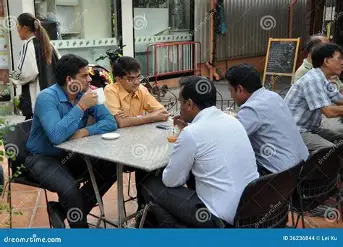
No coffee. No spirit level. You are not having a good day, are you? It is time for a cold beer. Half a dozen locals are gathered around their favourite watering hole, and they smile when you pull up a stool and join them. Their English is no better than your Thai. There are pauses in the conversation while you both try to find the word you want in each other’s language.
It doesn’t seem to matter. They smile the smile of encouragement in your direction, willing you to join in their repartee and banter anyway. You say how hot the weather is today. Not an earth-shattering observation but everyone is happy and enjoying the beer and the company.
You catch only a few words of what they are saying. But you understand that they are talking about a friend who has been diagnosed with terminal cancer. Everybody hopes he will get better, or at least be more comfortable in the months ahead. Their smiles of sadness are not uncaring or disrespectful.
Your bar mates are looking on the bright side, when more medication and care from family and community will make his last days as pain-free as possible. His being with friends at home is seen as something to smile and be happy about.
They change the subject to what all keen bar-goers are good at: putting the world to rights.
Whether it’s how they’d deal with the traffic jams in Bangkok or how flood control needs to be more effective, everyone has an opinion. Everyone has something to say. Some agree; some disagree. No one stops smiling. The smiles of agreeing and the smiles of disagreement merge seamlessly. Very different from the way arguments can get heated or serious in the West.
One of your drinking partners talks of a boundary dispute he has with a neighbour. He is not uptight about a few metres of land but his neighbour’s longan trees are towering over his garden and getting dangerously near his house. He has tried poot wan, sweet talk. He has tried compromising by suggesting the neighbour prune back only the larger branches.
He says he calmly walked away, knowing that getting angry would not have helped. He will go to the village headman and something will be sorted out.
I am sure readers will have guessed that when he walked away he was smiling. The smile of avoiding conflict.
The world always looks brighter from behind a smile
Please feel free to write us about your own experiences about this subject.
We’d love to hear your story.
Some of the Posts on My Website
https://understanding-thailand.com/my-published-posts/
A Summary of Thai History
https://en.wikipedia.org/wiki/Outline_of_Thailand
There’s a problem with the context box, created by 5 inexperienced salesgirls at BN-BIG C-CHIANGMAI. The watch works okay but they’ve mucked up the comments boxes on my WordPress posts.
Here’s a comment that should have appeared in the comments I received in this post, Thai Smiles — More Examples
“A very comprehensive set of articles of the Thai Smile, accurately explaining a complex subject with thoroughness. And yes, it’s difficult for a non-Thai to understand.
After getting my degree at Taunggyi University, Shan State, Myanmar, I left for a much safer life in Thailand. It’s not always easy for people from Myanmar to enter Thailand. Sometimes, bribes need to be given. But, because Thailand needs cheap foreign labour to do the jobs Thais don’t want to do, and because they need highly qualified workers in specialist fields, Myanmar people are accepted with a smile.
Those smiles are not genuine, they’re fake. I knew that then. I know that now.
But, I want to stay here. It’s better than Myanmar. So, I smile back with the same fake smile.
Pimsiri”
My apologies. I’m trying to fix it permanently, by avoiding Thai computer systems staff.
The content and final editing remain my own.