

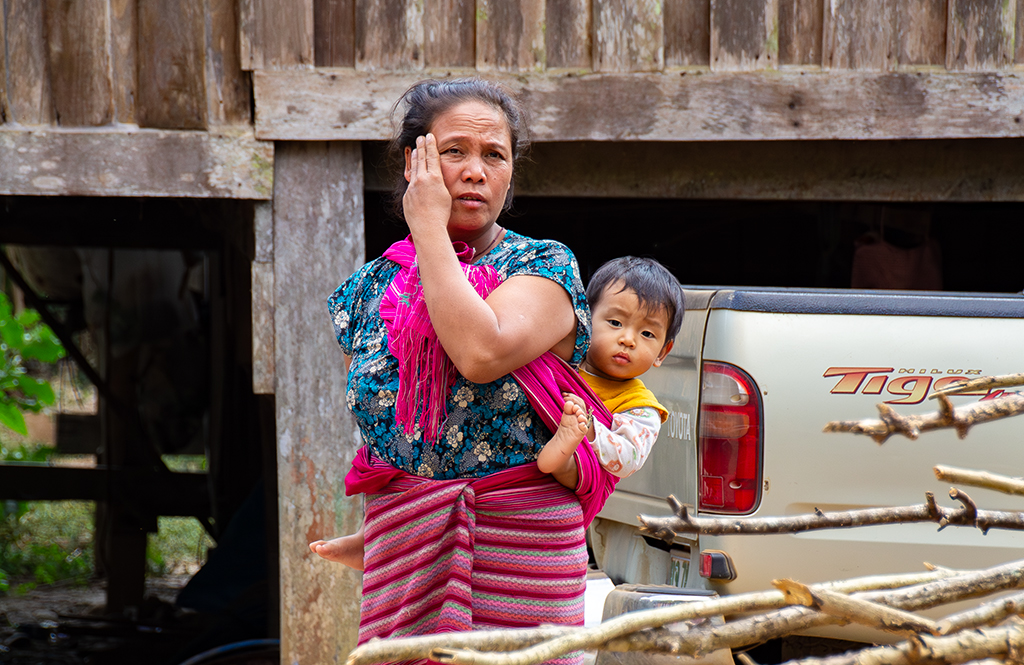
Karen Hill-Tribes; Christian and Animist
Introduction: The Karen People
Karen Hill-tribes; Christian and Animist. The Karen people, living across the mountainous borderlands of Thailand and Myanmar, have long been associated with the “long-neck women”, their colourful woven textiles, and their rustic bamboo houses perched on hillsides.
The Karen are more than subjects of curiosity for the tourists wanting photo opportunities with them. Yes, they make money by allowing themselves to be photographed by camera-wielding tourists, but essentially the Karen hill-tribes are a poor people with strong cultural and religious beliefs. They successfully merge their Christian faith with their animist beliefs.
The Karen left Tibet and China 2,000 years ago as refugees and settled in Myanmar (Burma). Around 1997, they again became refugees, fleeing from the brutal military campaigns and ethnic cleansing tactics of the Myanmar junta and the military, the Tatmadaw. There was limited support from neighbouring countries.
My own visit to a Karen village several years ago was revealing. Friends who initially sought photographs of “long‑neck girls” soon discovered the warmth of a Christian service and the hospitality of a shared meal. That moment reminded me that culture is not a spectacle but a lived reality, rooted in Christian belief and faith, merged successfully with animism.
For the Karen, God, the creator, is in the nature that is around them.
Animism is not mere superstition; it’s a real belief in the creator God.
As the English poet and hymn writer, Dorothy Francis Gurney (1858-1932), said, “You are nearer to God in a garden than anywhere else on Earth”.
https://en.wikipedia.org/wiki/Dorothy_Gurney
The Merging of Christianity and Animism
Many communities embraced Christianity through missionary contact in the nineteenth and twentieth centuries, yet they did not abandon their animist traditions. Instead, they wove the two together into a distinctive spiritual fabric.
A Sunday service may include hymns sung in the Karen language, prayers to the Christian God, and rituals that honour the spirits of forest, river, and mountain. Far from contradiction, this blending reflects a worldview in which divine presence permeates nature.
During my visit, I witnessed this integration first‑hand. After the formal service, villagers spoke of God’s creation not in abstract theological terms but in relation to the trees, streams, and fields that sustained their lives. For them, animism is not superstition but recognition of the sacred in everyday surroundings.
Dorothy Francis Gurney’s famous line, “You are nearer to God in a garden than anywhere else on Earth,” resonates deeply here. The Karen do not separate faith from environment; they experience the divine in the soil beneath their feet and the sky above their homes.
Christianity provides a sense of global belonging. Animism anchors them locally, affirming ties to ancestral land and spirits. Together, these traditions offer resilience to a people long suffering as refugees and who are being marginalised wherever they go. To dismiss animism as primitive or Christianity as imposed is to miss the creative way the Karen have made both their own. Their religion is not borrowed but lived, a testimony to adaptability and depth.
Tourist Exploitation and the ‘Long Neck’ Image
Tourism has brought both visibility and vulnerability to Karen communities. The most recognisable image is that of the so‑called “long‑neck women,” whose brass coils elongate the neck by pressing down the collarbone.
Originally, this practice carried cultural and symbolic meaning, linked to beauty, identity, and sometimes protection. Yet in many villages today, the rings have become a spectacle for visitors, marketed as exotic curiosities rather than respected traditions.
When I visited a Karen village with French friends, their first instinct was to photograph the women and children wearing the coils. The scene was familiar: tourists arriving with cameras, eager to capture what they had seen in guidebooks.
But the experience shifted when we were invited to join a Christian service. The hymns, sung in the Karen language, filled the bamboo church with a quiet dignity. Afterwards, we shared a simple meal of rice and vegetables. In that moment, the community revealed itself not as a tourist attraction but as a living culture, rooted in faith and hospitality.
My friends left with fewer photographs but a deeper respect.
On one hand, tourism provides income in areas where economic opportunities are scarce. Villages often rely on visitor fees and handicraft sales to support families. On the other hand, the constant gaze of outsiders is a problem.
Women wearing coils may feel pressured to maintain the practice for financial survival, even if younger generations question its relevance. The danger lies in culture being frozen for display, rather than allowed to evolve naturally.
Responsible tourism requires more than curiosity. It asks visitors to look beyond the brass rings, to listen to stories, to share meals, and to respect rituals. It means recognising that behind every photograph is a person whose life is shaped by faith, hardship, and resilience.
To see the Karen only through the lens of exoticism is to miss their humanity. To engage with them as neighbours is to honour their dignity.
Life in Border Camps
For many Karen families, life is not lived in the villages that tourists visit but in the sprawling refugee camps along the Thai–Myanmar border. These camps, established decades ago, were meant to be temporary shelters for those fleeing conflict in Myanmar. Yet for thousands of Karen people, they have become semi‑permanent homes, places where generations grow up without ever knowing the security of citizenship.
The camps are crowded, with bamboo huts pressed close together and narrow paths winding between them. Families often share small spaces, with limited access to clean water and sanitation. Food supplies depend heavily on international aid, and shortages are common.
Healthcare is minimal, with clinics struggling to meet the needs of malnourished children, pregnant women, and the elderly. In this environment, resilience is not a choice but a necessity.
Statelessness compounds the hardship. Without official identification, Karen refugees cannot travel freely, seek formal employment, or access higher education. Young people grow up in limbo, their futures constrained by paperwork they do not possess.
Some attempt to leave the camps illegally to find work in Thai cities, risking arrest or exploitation. Others remain, caught between the hope of resettlement abroad and the reality of indefinite waiting.
Yet even in these conditions, community life persists. Children play football on dusty clearings, women weave traditional textiles, and elders tell stories of ancestral villages across the border. The Karen spirit endures, even when political borders deny them recognition.
The border camps symbolise both the resilience and the vulnerability of the Karen people. They are places of survival, but also of stagnation. To understand Karen culture fully, one must look beyond the tourist villages and into these camps, where the struggle for dignity continues daily. Their story is not only about tradition but about endurance in the face of uncertainty.
Education Barriers
Education is often described as the key to breaking cycles of poverty, yet for many Karen children it remains out of reach. In the villages and border camps, schools are few, resources are scarce, and opportunities are unevenly distributed. Where classrooms exist, they are often overcrowded, with one teacher responsible for dozens of pupils.
Textbooks may be outdated or incomplete, and lessons are frequently interrupted by shortages of supplies or the need for children to help their families with farming and household work.
Language presents another barrier. Many Karen children grow up speaking their own dialects at home, but schooling is conducted in Thai or Burmese. This linguistic gap makes learning difficult, and some children fall behind or drop out altogether.
Without adequate support, they struggle to bridge the divide between their mother tongue and the national language, leaving them disadvantaged in examinations and future employment.
Distance compounds the problem. In rural areas, children may walk several kilometres each day to reach the nearest school. The journey is tiring, and during the rainy season paths become treacherous. Some families, faced with the choice between education and safety, keep their children at home.
Others cannot afford the costs of uniforms, books, or transport, even when tuition itself is nominally free.
The consequences are profound. Limited education perpetuates cycles of poverty and restricts access to skilled jobs. Young Karen people often find themselves confined to low‑paid labour, with little chance of advancement. Yet aspirations remain strong. Many children express dreams of becoming teachers, nurses, or community leaders.
Their determination highlights both the urgency of the problem and the potential that could be unlocked with better support. Education is not simply about literacy; it is about dignity, opportunity, and the chance to shape a future beyond survival.
Health, Poverty, and Exploitation
Beyond the challenges of education and displacement, Karen communities face persistent struggles with health and poverty. In remote villages and border camps, access to medical care is limited. Clinics are often understaffed and under‑resourced, with shortages of medicines and equipment.
Preventable illnesses such as diarrhoea, malaria, and respiratory infections remain common, and malnutrition affects many children. For families already living on the margins, the cost of treatment can be prohibitive, forcing them to rely on traditional remedies or endure illness untreated.
Poverty is not only a matter of income but of opportunity. Many Karen people lack secure land rights, leaving them vulnerable to eviction or exploitation. Without citizenship papers, they cannot claim legal protection or access government support.
As a result, they are often employed in low‑paid, insecure jobs, particularly in agriculture and construction. Migrant labourers may work long hours for minimal wages, with little recourse if they are cheated or abused. Women are especially vulnerable
Conclusion
The Karen people’s unique spiritual combination of Christianity and animism is the heart of their identity and resilience.
Their Christian faith provides strength despite their refugee status, poverty, and feeling of being oppressed in their “host” countries. It anchors them to their ancestral lands and spirits, even as political borders and refugee camps challenge their sense of belonging.
The Karen do not see faith and environment as separate; rather, they experience God in the soil beneath their feet, the rivers that flow, and the forests that shelter them.